German statutory health insurance tenders are published EU-wide, but not in a shape that maps onto a product portfolio. TenderMonitor matches notices to your supplier identifiers and puts the price data next to them. The module is currently in a pilot phase.







The notice is published EU-wide, yet nothing in it says whether a lot concerns your products. Lots carry the active substance and often an ATC code, but the notation is not standardised. In our analysis of 266 German notices for section 130a contracts between June and August 2026, 75 per cent did not contain the string "ATC-Code" and 14 per cent carried no ATC code at all. A filter tuned to one string loses most of the relevant lots.
Submission windows are short and the search is manual. Time spent establishing whether a lot is even relevant is time taken from preparing the bid, and a lot found late is a lot not bid on.
A price-protection rebate is calculated against the day of dispensing, but invoiced long afterwards. Without the price levels for those dates, the invoice cannot be verified, only paid.
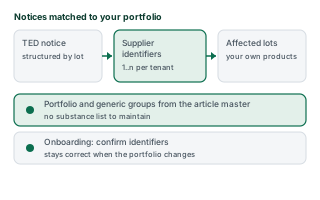
A tenant is defined by its supplier identifiers. Which products belong to it, and which generic groups they sit in, comes from the article master, so onboarding is "confirm your identifiers" rather than "upload your portfolio".

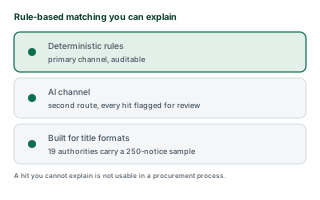
Detection stays deterministic and auditable. An AI channel runs alongside it as a second route to surface additional candidates, and those hits are explicitly flagged as requiring review.
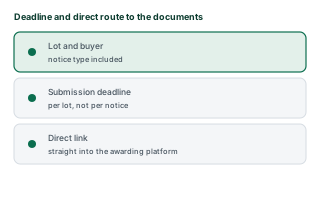
Every match carries its submission deadline and a direct link into the contracting authority's own procurement platform, so the step from notice to documents does not require a second search.
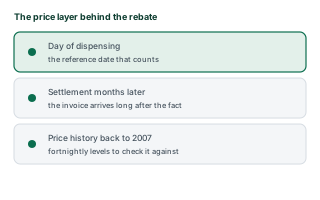
Open-house contracts frequently add a price-protection rebate referenced to the day of dispensing, with settlement following months later. Checking it requires the price levels on those exact dates.
German statutory health insurance rebate contracts under section 130a (8) SGB V, and the open-house procedures alongside them, are published EU-wide once the contract value reaches the threshold. The notice is therefore public, but it is structured by lot, not by article number. That is where the work starts: nothing in the notice tells you whether a lot concerns your products, so the match has to be made. TenderMonitor makes that match and puts the price data next to it.
Above the threshold, contracting authorities must publish EU-wide. Section 106 GWB derives the threshold from Article 4 of Directive 2014/24/EU as amended, and the figure is revised periodically, so the current value should always be read there rather than quoted from memory. Publication runs through TED, the EU's official journal portal. The tender documents themselves then sit on the contracting authority's own procurement platform.
A lot carries the active substance, the pharmaceutical form and often an ATC code, but the notation is not standardised. We measured this. In our own analysis of 266 German notices for section 130a contracts published between June and August 2026, 75 per cent did not contain the string "ATC-Code", and 14 per cent carried no ATC code at all. A filter tuned to one fixed string therefore loses most of the relevant lots.
The reassuring half of the same finding: a sample of 250 notices came from only 19 distinct contracting authorities. The market is carried by a manageable number of recurring title formats, and recognition can be built for those rather than relying on a single field being present.
A tenant is defined by its supplier identifiers, not by a maintained list of active substances. Which products belong to it, and which generic groups they sit in, comes from the article master. Onboarding is therefore "confirm your identifiers" rather than "upload your portfolio", and it stays correct when the portfolio changes.
Match detection stays rule-based and auditable. An AI channel runs alongside it, but only as a second route to surface additional candidates, and anything from that channel is flagged as requiring review. In a procurement process, a hit you cannot explain is not usable.
Open-house contracts rarely stop at the base rebate. A price-protection rebate is common on top: a supplier priced above the average of the cheapest suppliers makes up the difference, and the reference point is the day of dispensing in the pharmacy. Settlement follows later. Checking that settlement requires the price levels on those exact dates, not today's price.
This is why tender monitoring and price data belong together. pharmazie.com holds the German price history back to 2007 with fortnightly price levels, so a settlement can be checked against the actual market position rather than against recollection.
Four clarifications, because procurement work does not tolerate vagueness. First, TenderMonitor is a module in a pilot phase: scope is being defined with pilot customers and no pricing model has been published. Second, it does not replace procurement advice; it finds and matches. Third, the prices agreed inside a specific contract are generally not public, what is visible is the notice, the lot and the award. Fourth, from 2027 German legislation shifts tendering towards groups of active substances rather than single substances, which affects any logic assuming exactly one ATC code per lot. We are building for that and prefer to say so in advance.
The quickest way to judge fit is a 30-minute demo. Bring your supplier identifiers and a tender you worked on recently, and we will run the matching live.
More clarity, faster research, and faster decision-making.




.png)