



Key BenefitsThe REHADAT partnership provides structured information on assistive products and how they are supplied. The database documents assistive products together with manufacturer and distributor addresses, and adds visual representations and dimensional specifications so that a product can be identified quickly. It covers application areas, financing, the regulatory framework and practical examples of workplace adaptation.
REHADAT is a service provided by the Cologne Institute for Economic Research (IW Koeln) and funded by the Federal Ministry of Labour and Social Affairs (BMAS).
The GKV aids register lists all products recognised by the statutory health insurance funds as aids, including the products of the nursing aids list.
Aids are organised through a four-part position number:
Example: the walker type 26-22 from Ortopedia GmbH carries the product number 10.46.02.1003, where 10 stands for walking aids, 46 for indoor application, 02 for the walker subgroup and 1003 for the specific type.
Once a position number is selected, users can branch directly from the drug pricing view into the REHADAT database.
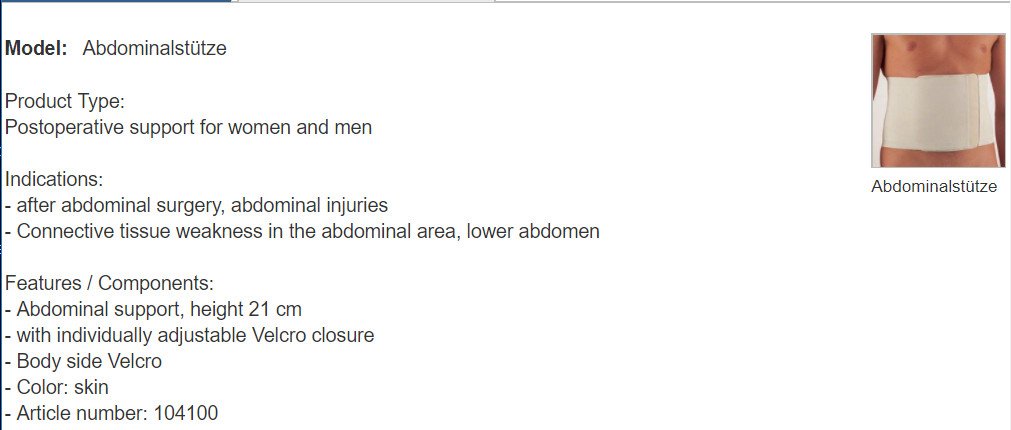
Hosted at IW Koeln, the database documents almost all technical aids for people with disabilities available in Germany, covering home care, orthoses, prosthetics and accessible equipment. Each entry provides manufacturer and sales addresses, prices, technical descriptions and guidance on cost coverage by the health insurance funds. Many entries include drawings and photographs.
Assistive products in Germany sit at the intersection of medical need, reimbursement rules and a fragmented data landscape. Purchasing teams, health insurance staff and hospital pharmacies frequently need to identify a specific aid, confirm its position number and understand how it is reimbursed, often working from incomplete descriptions.
The REHADAT portal is run as a publicly funded, vendor-neutral project. That neutrality matters when a product has to be identified and compared without commercial bias.
The four-part position number is the connecting key. Once it is known, it links a product to its group, application and reimbursement context, and provides the bridge from pricing data into the descriptive REHADAT record.

.png)