





We have to read our orders into the warehouse management system, because otherwise our whole goods receipt does not work.
Management, pharmaceutical wholesaler
A tool that does not reach the warehouse management system does not save a step, it adds one. Whatever happens in the MSV3-Client still has to be posted by hand afterwards, and until that posting exists, goods receipt, stock and purchasing are all working from a picture that is already wrong.
Right now everything still runs by email and then of course gets entered by hand accordingly.
Management, pharmaceutical trade
Every order is written once, sent once and typed in again at the other end. The cost is not one dramatic failure but a steady tax on every line item, paid in typing, in chasing confirmations, and in the errors that only surface when the goods arrive.
When you see the costs for an MSV3 connection, that really is no small change.
Head of hospital pharmacy
An MSV3 connection competes with everything else in a budget that was planned months ago, and the return is hard to prove in advance. So the decision stalls, not because nobody wants the interface, but because nobody can put a number next to it that survives the next budget round.
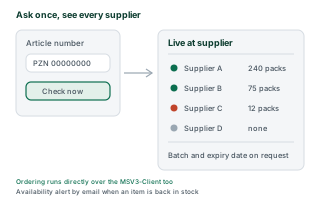
The MSV3 interface is the German standard interface for real-time availability checks, and this is the part of the MSV3-Client that is live and productive today. You enter the article, you see which of your suppliers can deliver and in what quantity, before you commit to a purchase.

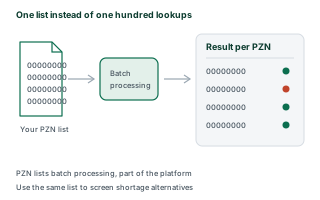
PZN lists batch processing is a platform capability, so you hand over the list you already keep instead of typing article numbers one by one. The PZN stays the key, which means the result maps straight back onto your own master data.
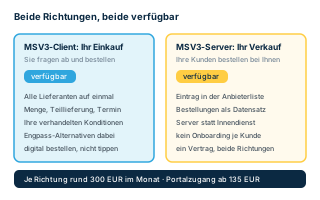
This is the question we get asked most, so we state it plainly: both directions of the MSV3 interface are available. Through the MSV3 client you check availability and place orders. Through the MSV3 server you appear in the standard's official supplier directory and take in orders as structured data instead of retyping them from fax and email.
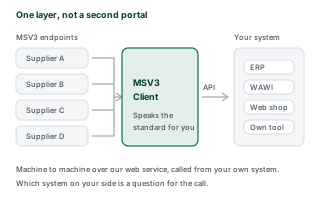
The MSV3-Client speaks MSV3 so your team does not have to implement the standard itself. It can be driven over our REST API and web service, which enables machine-to-machine communication so you use our data and functions on your own IT systems.
Both directions of the MSV3 interface are available at pharmazie.com, integrated with 25+ databases in one search, for healthcare professionals only. The MSV3-Client runs a real-time availability check across your connected suppliers from a single query, so you see who can deliver a product now instead of opening each wholesaler in turn. You see daily who can deliver and in what quantity, and you place orders directly.
MSV3 is the German standard interface for real-time availability checks between pharmacy systems and suppliers. The MSV3-Client speaks the standard for you, so your team does not implement it itself, and the query returns availability, your individually negotiated terms and the quantity a supplier can actually deliver. When a supplier can only cover part of an order, the protocol reports that too, so a partial fill is visible before you commit.
You rarely check one article at a time. PZN lists batch processing lets you hand over the list you already keep and check every article's availability in one pass instead of typing article numbers one by one, which is the routine most teams describe when they describe this pain.
This is the part we get asked about most, so we state it plainly. Availability checks and ordering both run over the MSV3-Client, the German standard for real-time queries. You see daily who can deliver and in what quantity, and you place orders directly, without leaving your research.
The second direction is just as available. Running an MSV3 server puts you in the standard's official supplier directory. Your customers set you up once as a supplier and order digitally from then on, with no onboarding per customer. Orders arrive as structured data instead of as a fax, and the availability question is answered by the server rather than by your back office.
Around 300 EUR per month per direction, and portal access with 25+ pharmaceutical databases from 140 EUR per month, all prices net plus VAT. The exact price depends on the number of workplaces and the data scope. The MSV3-Client reaches German MSV3 endpoints, since MSV3 is a German standard, and it can be driven from the system you already work in over our REST API and web service rather than as a second portal. In two warehouse management systems for pharmaceutical wholesale the connection is already implemented natively, one of them is Sage 100.
The fastest way to judge fit is a 30-minute demo with your own supplier connections. Bring a PZN list you check often and we will run the live availability query together.
More clarity, faster research, and faster decision-making.




.png)