





We do not have it in our system, so we have to transfer and maintain it by hand. That is a huge manual effort in the research.
Employee, Purchasing
Every article you research somewhere else has to be entered again where you actually work. The second entry is where the typos, the stale pack sizes and the wrong PZNs come from, and nobody has time to check them line by line. The workaround holds because it is faster to retype than to explain to IT why an interface is needed.
An interface from our hospital system [to your solution] would be the ideal way.
Employee, hospital pharmacy
The data exists, the system exists, and between them sits a person with a browser tab and a clipboard. Every research tool that cannot be reached from the ERP, the merchandise system or the shop becomes an island, and the work of bridging that island never appears in any budget. It stays that way because the bridge is a project and the copy and paste is a Tuesday.
We have a history of 15 years of bad master data behind us and now we want to look at the quality of our data.
Employee, pharmaceutical company
Bad master data does not announce itself. It shows up as an order for a pack size that no longer exists, as a supplier who was taken over two years ago, or as an article you keep listing after it left the market. Once a record is wrong it gets copied forward, which is why the problem is measured in years rather than in rows.
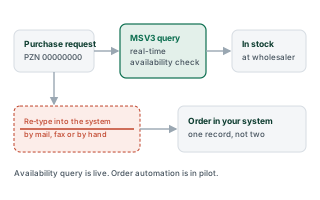
The MSV3 interface is the German standard interface for real-time availability checks. Instead of opening each wholesaler portal one by one and typing the PZN into every single one, you ask once and see who has stock.

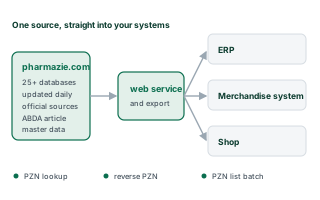
API and data services let you use our data inside the system you already work in, rather than beside it. That is the difference between researching an article and having the article.
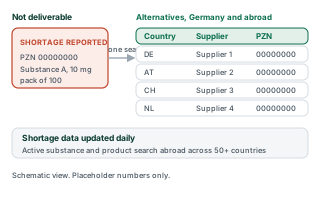
When an article stops moving, the question is never whether there is a shortage. It is what you order instead, from whom, and under which PZN. The shortage flag and the alternatives sit in the same view, so you do not open a second website to find out.
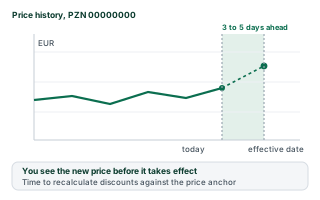
Purchasing runs on price anchors, and the anchor moves. Current price data is visible 3 to 5 days before the effective date, which is the window in which a discount calculation can still be corrected rather than explained afterwards.
pharmazie.com gives pharmaceutical buyers a single search over 25+ databases, so availability, shortage alternatives and prices come from one place instead of three. Purchasing teams check what a wholesaler can deliver in real time, find a substitute when an article stops moving, and see a price change before it takes effect, without copying article numbers from one system into the next.
The slow part of purchasing is rarely the decision, it is confirming that the goods actually exist. The MSV3 client interface, the German standard for real-time availability checks, is live and productive: you query your connected wholesalers at the moment you ask and see who can deliver, at your own conditions. Ordering over MSV3 is live and productive, so today the MSV3 client is where you confirm availability and place orders.
Buyers do not want a second portal open all day. Our web service allows machine to machine communication, so a price comparison or a PZN lookup runs inside your ERP or warehouse system, and data downloads arrive in the scope, frequency and format you define. That is the difference between researching next to your process and buying inside it.
When an article stops moving, the question is not whether there is a shortage, it is what you order instead. Germany's reported shortages, updated daily from official sources, sit next to the alternatives that answer them: the same active substance, dosage form and strength, and where nothing German fits, an equivalent from another market. You can also check a whole PZN list in one batch instead of one article at a time.
The pattern repeats: the same data typed twice, an interface that will not hand data to the ERP, and master data nobody fully trusts after years of patching. What changes here is that the price anchor arrives early, current price data is visible 3 to 5 days before its effective date, so conditions are recalculated before they go live rather than after. One honest limit: we do not publish a fixed daily update time, so if your process depends on data landing at an exact hour, say so up front.
The fastest way to judge fit is a 30-minute demo on your data. Bring a PZN list or an item you are struggling to source, and we will run it live.
More clarity, faster research, and faster decision-making.




.png)