Importers, re-importers and specialty distributors use pharmazie.com to compare prices across 50+ countries, find equivalents when a product goes short, and check wholesaler availability. Without logging into a different database for every question.







It's tedious to search every national database separately just to get price information. We need one central point of access to keep suppliers honest.
Head of Sourcing, European pharmaceutical wholesaler
Every market means another portal, another login, another export that doesn't match the last one. The cost isn't only the hours. It's buying decisions made on incomplete data, and arbitrage that was there and got missed.
We have to spot alternatives quickly when something goes short, ideally equivalents from other European countries, so we can keep supplying.
Head of master data management, pharmaceutical trader
The shortage itself is public information. What's missing is the next step: which equivalent exists, in which country, and whether it can actually be sourced. Without that, a shortage is lost revenue and a customer who calls someone else.
Our legacy system's interface is dated and takes too many clicks. We need an intuitive search and simple data exports for our own analysis.
Managing director, re-import specialist
Too many clicks to reach a single answer, and then no clean way to get that answer into Excel, so it gets retyped. The workaround quietly becomes the job.
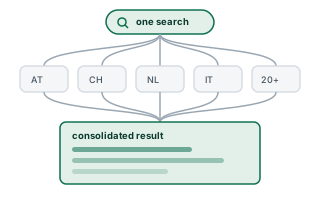
Reference prices exist, they just live in dozens of different places. The international databases bring price and authorisation data from 50+ countries into a single result, so you can compare before you commit rather than after.

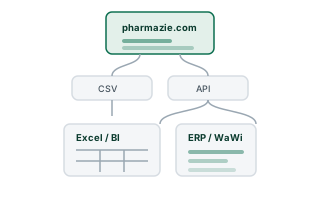
Traders told us the same thing repeatedly: the analysis doesn't happen in the database, it happens in Excel or in the ERP. So the export isn't an afterthought here. Advance price information, price history and your own lists all leave the platform cleanly.
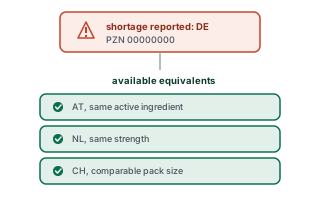
Germany's shortage reports, updated daily, sitting next to the international data that tells you what to do about them. When a pack goes short, the equivalents are already in the same view.
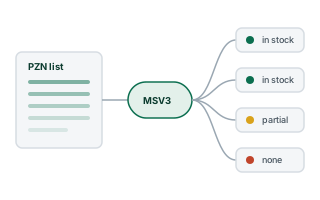
Researching a product and checking whether anyone has it are the same job, split across two systems. The MSV3 connection closes that gap: your existing wholesaler credentials, queried from inside the search.
pharmazie.com is a B2B drug database that brings international price, availability and authorisation data into a single search. Importers, re-importers and specialty distributors use it to compare what a product costs across 50+ countries, find equivalents when a pack goes short, and check wholesaler availability, without opening a separate portal for every question.
Cross-border trade runs on reference prices, and those prices sit in dozens of national systems. Instead of logging into each one, you run a single query across 25+ pharmaceutical databases, including the ABDA article master data and international price and authorisation data. The German pack, its equivalents in other European markets and the authorisation holder appear side by side, so a sourcing decision rests on a reference rather than a quote. Coverage is deepest in Europe, and some non-European markets are already included. A re-import is not marked by a single flag: you identify it by comparing manufacturer and marketing authorisation holder against the original.
A shortage report on its own only tells you what you cannot buy. The value is the next step: which equivalent exists, in which country, and whether it can actually be sourced. Germany's shortage data, updated daily, sits next to the international equivalents that answer it, and you can filter for products where no alternative exists at all.
Researching a product and checking whether anyone has it are the same job, usually split across two systems. The MSV3 availability query closes that gap and runs on your existing wholesaler credentials, stored encrypted and used only to ask on your behalf, so you never trade under anyone else's account. Ordering over MSV3 runs through the same connection, so checking availability and placing the order are one step instead of two.
The reasons traders switch repeat: an interface with too many clicks, data that will not export, and coverage that stops at the German border, which is exactly where this business begins. The analysis rarely happens in the database anyway, it happens in Excel and in your ERP: prices, price history and your own PZN lists export to a spreadsheet, or move through the API into your system. The export from the interface has a volume limit that most day-to-day work stays under, and for larger volumes there are individual data services that do not. Switching costs are real and nobody pretends otherwise.
The fastest way to judge fit is a 30-minute demo on your data, not ours. Bring a PZN list or a market you are trying to source in, and we will run it live.
More clarity, faster research, and faster decision-making.




.png)