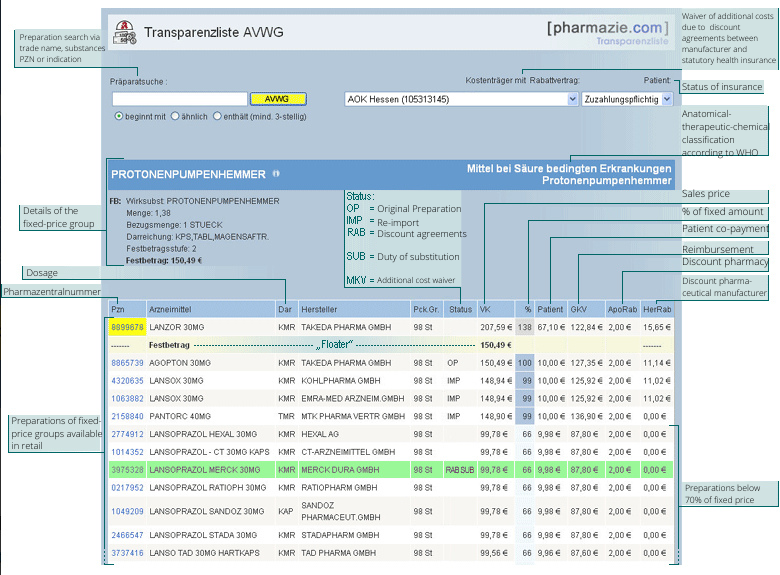





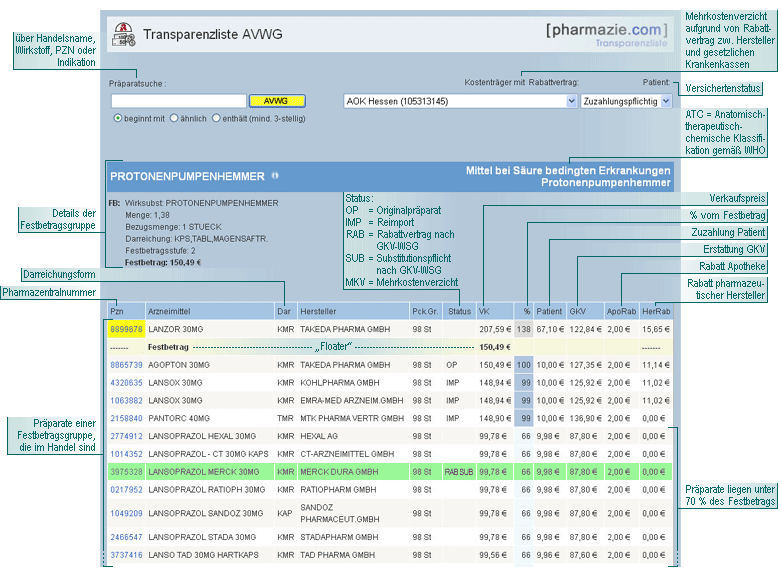

Key BenefitsThe Transparency List AVWG compares the prices of original preparations, generics, and reimported products in the German market. It applies the economic logic of the Arzneimittelversorgungs-Wirtschaftlichkeitsgesetz (AVWG) and its Bonus-Malus considerations, so that every listed pack can be assessed on a purely economic basis.
Tabular overviews are supplemented by compact economic and pharmaceutical information on each listed medicinal product. The focus stays deliberately on the economics of drug therapy. The list does not address clinical aspects of substituting original preparations.
For each comparison, the list shows the economic factors that determine what a therapy actually costs the payer, the pharmacy, and the patient:
The Transparency List draws on the Drug Pricing database for Germany inside pharmazie.com, sourced from AVOXA ABDATA in Eschborn. The economic changes in the German market are updated every 14 days, which gives market access, trade, and payer teams a dependable basis for their calculations.
Access is included in the Drug Pricing and Premium subscription packages.
Line up the economically relevant alternatives for a molecule side by side, from the original preparation to generics and reimported packs, so the most cost-effective option is easy to identify.
The list reflects the economic logic introduced by the AVWG, so prescribing and dispensing decisions can be judged against their financial consequences.
See how statutory reimbursement, patient co-payments, and manufacturer or pharmacy discounts combine for each listed product.
Every figure is based on AVOXA ABDATA data maintained in pharmazie.com and refreshed every 14 days, for reliability you can plan around.
The Arzneimittelversorgungs-Wirtschaftlichkeitsgesetz (AVWG) came into force on 1 May 2006 with the goal of curbing statutory health insurance spending on medicines. It lowered fixed amounts (Festbeträge) and reshaped the economic incentives around prescribing and dispensing. Understanding those mechanics is essential to reading any price comparison in the German market correctly.
Under the AVWG, statutory funds may exempt a medicine from patient co-payment when its price sits at least 30 percent below the applicable fixed amount. That single threshold moves demand, so the distance between a pack price and its fixed amount is one of the most consequential figures in the market.
The AVWG tied prescribing behaviour to economic targets, rewarding cost-effective choices and setting penalties for therapies that exceed defined cost benchmarks. The Transparency List translates these considerations into concrete per-pack economics.
Generics and reimported packs create the price competition the legislation intended to encourage. Comparing them on a consistent economic basis, including reimbursement, co-payment, and discount effects, is exactly what the Transparency List is built to do.

.png)