For the people in purchasing, product management, pharmacy management and quality assurance who keep the article master current. Take daily updated drug data in your own scope, frequency and format, so the manual comparison stops being your job.







The manual effort for several hundred preparations is simply too high.
Head of pharmacy, hospital pharmacy
Every preparation checked by hand is a small task that never ends, because the market keeps moving underneath it. The work does not produce anything new, it only stops the article master from drifting, so it is easy to defer and expensive to skip. It stays manual because no single tool owns the comparison, so a person does.
We constantly have to adapt our article master data to market changes, for example to new PZNs or article changes.
Data operations, international aid organisation
The article master is only ever as current as the last update someone remembered to make. New PZNs appear, existing products change and discontinued ones linger, all outside your organisation and none of it announced to you. When the data quietly falls behind, it surfaces later as a wrong order or a miscalculation.
The ERP integration is complex and may require external service providers.
Management, large online pharmacy
Good data still has to land inside your system in a shape it can read, and that step is where the effort hides. A format that does not match means either a manual reworking every cycle or an outside contractor, and both turn a data question into a project. The complexity is not in the data, it is in the last stretch into your system.
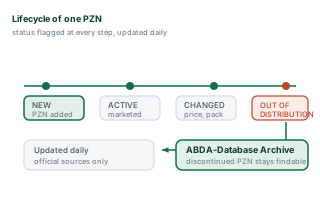
The platform is updated daily from 25+ databases and only from official sources. Every product carries where it sits in its lifecycle, so a new PZN, a changed article or a discontinued one reaches you as a status rather than as a surprise.

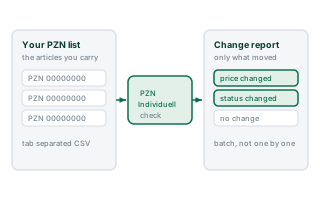
You do not have to take the whole market to keep your own list clean. Hand us the PZNs you actually carry and you get a report on the prices and statuses that moved, so the recurring check stops being a manual comparison.
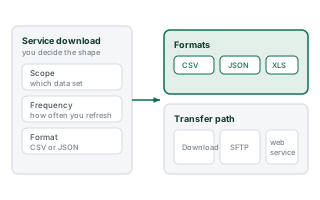
In the service download you decide which data you take and how often you refresh it, and you define the file format that best suits your system. The file arrives ready to read, not as the starting point for another round of cleanup.
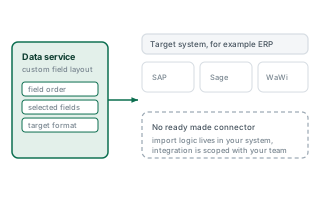
When your system needs a specific field order or layout, we can prepare it as a service instead of leaving you to reformat every delivery. What we do not have is a ready made connector that installs into SAP, Sage or Navision, so the connection itself is still work on your side.
pharmazie.com keeps your article master data current from official sources, so you stop reconciling several hundred preparations by hand. The platform is updated daily from 25+ pharmaceutical databases, including the ABDA article master data (German Drug Pricing), and every product carries a status on where it stands, so a change to a PZN, a price or an authorisation reaches you as a flag rather than as a surprise at month end.
You do not have to take the whole market to keep your own list clean. Hand over the PZNs you actually carry and you get a report on exactly what moved: prices, status, and the products that were discontinued or replaced. This is the PZN individuell function, and it turns a manual comparison across systems into one file you can act on.
In the service download you decide which fields you take, how often you refresh them, and the file format your system reads. Where your target system needs a specific field order or layout, we can prepare the file as a service instead of leaving your team to reformat every delivery. The point is that the data lands ready for import, not ready for another round of cleanup.
Two routes cover most setups. You can pull live queries through our API, or receive automated deliveries by SFTP push in formats such as CSV or JSON. Which one fits depends on how your system prefers to receive data, and that is a question worth settling before a project starts rather than during it.
Two honest limits belong on this page. To use the ABDA raw data you need an Avoxa licence, formerly ABDA, and that fee comes from the data source, not from us: our role is the technical delivery. The standard export is capped at 5,000 PZNs per export for licensing reasons, and larger volumes run under a separate raw data arrangement.
The fastest way to judge fit is a 30-minute demo on your data. Bring the PZN list you maintain today and we will show you exactly what a synced delivery would return.
More clarity, faster research, and faster decision-making.




.png)