





We jump between two systems. We look in the ERP and then want to check availability here.
Team, pharmaceutical wholesale
Every answer is assembled by hand from sources that do not talk to each other. The switching cost is invisible because it never shows up as a line item, it just sits inside every single lookup. And it grows with every source that gets added.
We don't want to click a lot. It is agonizingly laborious to search for a suitable, deliverable alternative.
Team lead, mail-order pharmacy
The work is not hard, it is repetitive, and that is what makes it expensive. Staff who could be answering clinical or commercial questions spend the time navigating instead. Nobody escalates it, so it stays.
I have to fetch all the articles and then use VLOOKUP to see whether one of my PZNs is affected by a price change.
Employee, pharma service provider
The PZN is the key that connects an internal article to the German market, and getting it is a manual detour through exports and spreadsheets. Each hand-built match is a place where an error can enter unnoticed. The next price change starts the whole routine again.
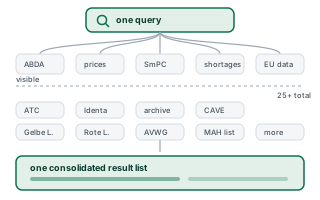
You type once and get one result list instead of querying each source on its own. The parallel search is the product we call Eisbergsuche, and it runs across the connected databases of the platform rather than a source you have to pick in advance.

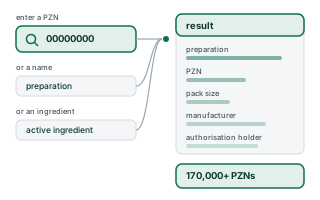
The PZN, the Pharmazentralnummer, is the unique German identification code for medicines and healthcare products. Enter one you already have to verify it, or search a preparation name or active ingredient to find it. The hit gives you the master data around it.
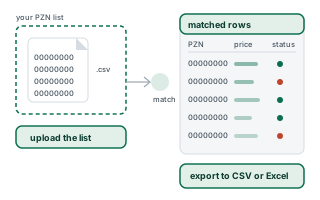
Checking an article list one PZN at a time is the routine most customers describe when they describe this pain. PZN lists batch processing takes the list instead of the single number, and hands back the matched rows.
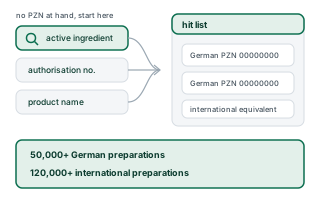
Not every search starts with a number. When a supplier names a product you do not carry, or a colleague abroad names a preparation you cannot map, the active ingredient or the authorisation number is the way in.
pharmazie.com lets industry professionals search a PZN, a product name or an active ingredient once and get one consolidated result list, instead of querying each source on its own. The PZN, the Pharmazentralnummer, is the unique German identification code for medicines and healthcare products. Enter one you already have, or find the one you are missing, and the hit carries the pack size, the manufacturer and the authorisation holder attached to it.
You do not need the number to start. Type the preparation name, part of the name or the active ingredient, and the result gives you the PZN together with the identifying fields around it. That matters when a supplier names a product you do not carry, or a colleague abroad names a preparation you cannot immediately map. The parallel search, which we call the Eisbergsuche, runs the query against the connected databases at the same time, so a single spelling reaches every source rather than one system at a time.
Working through an article list one number at a time is the routine most customers describe when they describe this pain: fetch the articles, then use a lookup in Excel to see whether any of your PZNs is affected by a change. PZN list batch processing takes the list you already keep and matches it against the current data set in one pass, so you get back what changed instead of confirming line by line what did not.
Active ingredient and authorisation number are search entry points in their own right, so identification does not depend on having the German number in hand. Where a product has international equivalents, the search connects a foreign preparation to its German counterpart, which is the step a purely national tool cannot take.
The reason teams consolidate is plain: jumping between an ERP and a separate lookup, then clicking through source after source, turns a two second question into a manual chore. The honest trade-off is that one platform still sits alongside the systems you already run, it does not replace them. What it removes is the tab switching, and the results export to CSV and Excel or move into your own systems through our API and data services when the search is one step in a larger process.
The fastest way to judge fit is a 30-minute demo on your data. Bring a list of PZNs you check regularly, and we will run it live.
More clarity, faster research, and faster decision-making.




.png)