The operational side of German drug pricing, for the people who execute the strategy. Watch tenders and rebate contracts, check where you sit against the four cheapest, and follow AMNOG procedures, in one search over 25+ databases.







Searching portals for tenders manually is time consuming. The relevance is high when something is overlooked.
Tender Manager, generics manufacturer
Tenders and open house contracts sit across several portals, so the search is a weekly manual sweep that never fully closes. The cost is not only the hours it eats, it is the one tender that slips through unseen. A missed deadline is not a small error in this workflow, it is a market you cannot bid for.
Open house contracts require complex calculations of the three cheapest competitor prices. That leads to manual tracking and billing.
Contract Manager, pharmaceutical manufacturer
Regulations like the price anchor tie your price to a moving set of competitor prices, so the number that matters changes without warning. Reassembling it by hand from several sources is slow and easy to get wrong. Every pricing decision then starts from a figure nobody is quite sure of.
The difficulty of retrieving price information from further back, for example 1.5 years, for rebate contract billing.
Compliance Manager, pharmaceutical manufacturer
Sick funds send invoices for rebate differences long after the fact, and checking them means knowing the price as it stood back then, not today. When the old figure lives in a source you no longer reach, the check stalls. The safe fallback becomes paying a claim you cannot verify.
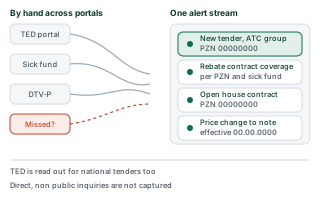
Tender and rebate contract alerts replace the manual sweep across portals with one stream. New tenders read from the EU TED database land next to the rebate contract coverage for a product, so you see per PZN which contracts already exist and with which sick fund.

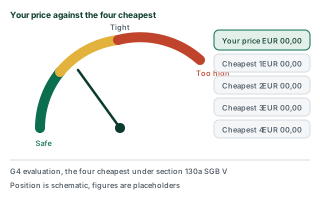
The G4 evaluation puts your price in relation to the four cheapest alternatives, the group that drives substitution and rebate exposure under section 130a SGB V. When a competitor moves, you see whether you are still safe or have slipped out of the group.
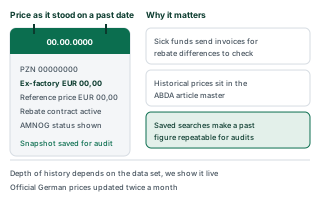
Historical price and contract data lets you retrieve what a product cost on a past date, so a rebate difference invoice from a sick fund can be checked against the figure that actually applied. Saved searches make the same audit repeatable rather than a one off reconstruction.
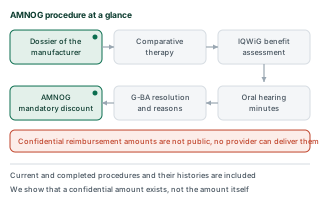
AMNOG information brings current and completed benefit assessment procedures into one view, so you follow a substance through its procedure instead of rebuilding the file from scattered documents. It is enough to see the status and its effect on your pricing, and honest about where the confidential parts stay confidential.
pharmazie.com brings German tenders, rebate contracts, reimbursement and AMNOG into one search, so the operational side of market access stops being a sweep across separate portals. You follow a substance from its tender to its rebate coverage to its benefit assessment in one place, and you can retrieve the price and contract picture as it stood on a past date when an audit asks for it.
Tender and rebate contract alerts replace the manual sweep with one stream. New tenders read from the EU TED database, the official source that also covers national tenders, and land in front of you instead of waiting to be found. You can save the ATC groups that matter to you as an alert basket and reuse it, so the relevant procedures come to you rather than the other way round.
The economic pressure in a rebate market comes from the group that drives substitution: the cheapest alternatives. The G4 evaluation puts your price in relation to the four cheapest options, so you see your exposure rather than infer it. The platform also shows rebate contract coverage per PZN and per sick fund, which is what makes it useful for reading the competitive field around a product.
Reimbursement work often has to look backwards. When a rebate difference invoice from a sick fund lands, you need what a product cost on a specific past date, not today's figure. Historical price and contract data lets you retrieve that record, so a dispute rests on the number that applied at the time rather than a reconstruction.
AMNOG information brings current and completed benefit assessment procedures into one view, from the dossier and IQWiG assessment through to the resolution, so you follow a substance without rebuilding the file each time. One limit we would rather state than let you discover: the agreed rebate amounts themselves are confidential and not public, and no provider can hand you those. What you get is the structure around them, which is what day-to-day decisions actually run on.
The fastest way to judge fit is a 30-minute demo on your data. Bring the ATC groups or products you track today and we will run the tender, rebate and AMNOG view live.
More clarity, faster research, and faster decision-making.




.png)