For contract management, drug referents and medical advisors at statutory and private health insurers who have to judge whether a prescription was correct and whether it was priced correctly. One platform for price history, Aut idem comparison and the directives behind a prescription.







I cannot see by how much the price was reduced in the course of the negotiations.
Consultant, health economics
The list price is public and the real price is not, so the number you work with is the one you can find rather than the one that applies. Every assessment built on it carries an error you cannot quantify. The gap stays open because the information sits with the parties who negotiated it, not with the people who have to check the result.
Specialist information is often not up to date.
Staff member, healthcare services provider
A document that was correct last quarter looks exactly like one that is correct today. Nothing on the page tells you it has moved on, so the decision gets made on the old version and nobody notices until an account is disputed. The cost is not the lookup, it is the rework and the financial exposure behind a wrong call.
Until now you sit there, take the standard German drug price list and go through every single PZN in Excel. Awful.
Manager, pharmaceutical company
The work is not hard, it is long, and it is exactly the kind of work that produces mistakes at row two hundred. The spreadsheet is also a snapshot: the moment it is finished, it is out of date. It survives because it is the only version of the process anyone has ever written down.
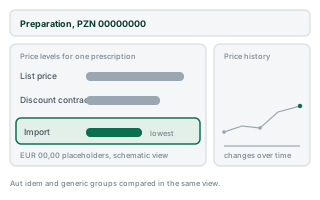
The platform is built around low-priced prescription under the aspect of discount contracts, AMNOG and imports. Instead of tracking price changes yourself, you look up the history behind a preparation and compare it against its alternatives in the same view.

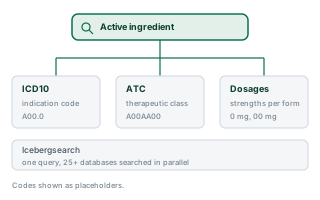
Checking a prescription starts with identifying what was prescribed and for what. You look up indications of drugs based on MedDRA, ATC and dosages, so the clinical context and the product record sit in the same place.
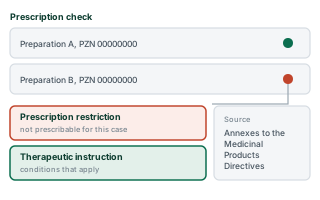
A prescription can be correctly priced and still not be prescribable. The platform carries restrictions on prescriptions and therapeutic instructions in accordance with the Annexes to the Medicinal Products Directives.
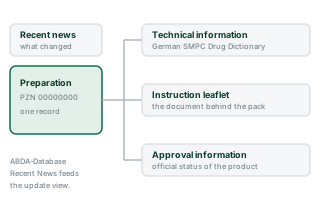
Behind every assessment there has to be a source you can point to. You get instruction leaflet and technical information with official approval information, attached to the product record rather than filed somewhere else.
pharmazie.com is a B2B drug database that lets payer teams check a prescription or an account for both correctness and cost in a single search. Instead of moving between price lists, generic-group tables and source documents, you identify what was prescribed, see what it costs, compare it against substitutable alternatives and open the official document behind the decision, all from one result.
A price on today's list is only half the picture. For an economic check you need to know how a price moved and what the lower-priced route would have been. Price history is part of every product record, so you can look up what an item cost on a past date rather than reconstruct it from memory, which is what makes a rebate difference or a retax defensible. Discount contracts, AMNOG and imports all feed into the low-priced-prescription view.
The core question in a formal check is whether a cheaper, substitutable product should have been dispensed. You compare prices across the Aut idem and generic groups with the Transparency List behind them, so the economic reason to substitute is visible in one comparison rather than assembled by hand. This is the best-covered need in this segment.
A prescription can be correctly priced and still not be prescribable. The platform carries restrictions on prescriptions and therapeutic instructions, and it lets you look up the indication behind a code by MedDRA, ATC and dosage, so you check the medicine against the condition it was written for. Behind each assessment sits the official document: technical information and the instruction leaflet with official approval, not a copy of it.
Some things no data source can hand a payer, and we would rather say so here. The rebate amount agreed in a discount contract is confidential and not public, so you see contract coverage per product and fund but not the negotiated figure. Fixed amounts are included, including co-payments broken down per individual insurer. Everything for the check runs from official sources, consolidated from 25+ databases.
The fastest way to judge fit is a 30-minute demo on your data. Bring a batch of prescriptions or accounts you are checking now and we will run them live.
More clarity, faster research, and faster decision-making.




.png)