PZNs mean nothing outside Germany. Code-Mapping is the connection between a German article and its EU and IDMP (Identification of Medicinal Products) equivalents, so a match on your side becomes a product you can actually buy or sell abroad.






Current solutions are incomplete or cannot be exported.
Buyer, pharmaceutical wholesaler
The systems built for the German market answer German questions well, but the international link is either missing or locked inside a screen you cannot get data out of. So the one thing you need, the connection between your article and its foreign counterpart, is exactly the thing the tool does not give you. The gap does not announce itself, it just quietly blocks every cross-border move.
We use manual processes to check the data, and they are time-consuming and error-prone.
Buyer, import pharmacy
When no system holds the link, someone builds it row by row in a spreadsheet. Each manual match is a place where a wrong number can slip in unnoticed, and the check never ends because the underlying products keep moving. The effort scales with the list, and it lands on people who should be buying, not reconciling.
We need EU marketing authorisation numbers for export, because PZNs mean nothing abroad.
Managing director, pharmaceutical wholesaler
A PZN identifies a product inside Germany and stops there. Without the EU or international number, a counterpart abroad cannot confirm what you mean, and the deal cannot proceed. The missing link is not a cosmetic detail, it is the difference between a transaction that happens and one that does not.
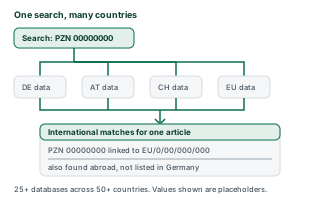
The value of Code-Mapping is that the databases are already connected, so one search reaches the international sources instead of you querying each national system on its own. This is the Eisbergsuche, the parallel search, and it also surfaces products that exist abroad but are not listed in Germany.

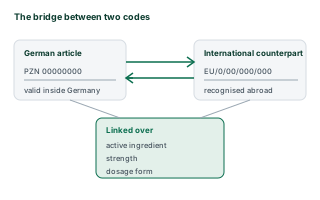
This is the core of the page: not the single lookup, but the relationship between a German PZN and its EU or IDMP identifier. The link is built over the active ingredient, strength and dosage form, so a German article resolves to the counterpart another party abroad can recognise.
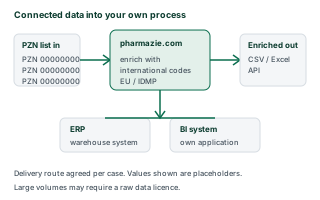
A mapping only creates value when it reaches the place where the business happens. Upload your PZN list to have it enriched, then take the connected data out as a defined export or through the API into your ERP, warehouse or BI system. The delivery route is agreed per case, the point here is what the data lets you do.
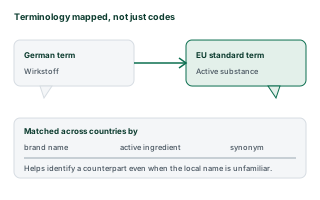
The bridge is not only numbers. Buyers and regulatory teams also need the German term connected to the European standard wording, so an active ingredient or product description reads the same on both sides. Matching by brand name, active ingredient and synonym is what makes a foreign counterpart findable at all.
pharmazie.com connects a German PZN to its European and IDMP equivalents in one search across 25+ databases and 50+ countries. A PZN identifies a pack in Germany and means nothing outside it, so buyers, regulatory and export teams use the platform to turn that national code into the international identifier a cross-border transaction actually needs.
The PZN is a purely national identification code. There is no direct line from it to an EU marketing authorisation number, which is why export work so often stalls on manual matching. The link has to be rebuilt over the active ingredient, the strength and the dosage form, and doing that by hand for every product is both slow and error prone.
Rather than one lookup at a time, the databases are already connected, so a single search reaches the international sources and returns codes that are not registered in the German data at all. The system builds the relationship over active ingredient, strength and dosage form, even where a clean one-to-one match per pack size does not exist. The bridge is not only numbers: the German term is connected to the standard European wording too, so an active ingredient reads the same on both sides of a transaction.
A mapping only earns its keep where the business happens. Upload your PZN list and get it back enriched with the matching EU numbers, instead of looking up each one in turn. For larger volumes processed in your own systems, for example beyond 5,000 PZNs, a raw data licence is usually required, because the licence terms come from the data source rather than from us.
The platform focuses on PZN and EU codes, including EMA and IDMP identifiers. Mapping to US-specific standards such as RxNorm is a possible extension, not something we present as built today. If your target market is Europe, this is where the coverage is deepest, and that is the scope we stand behind.
Bring a list you need mapped for export and we will run it in a 30-minute demo on your data, not ours.
More clarity, faster research, and faster decision-making.




.png)