Market access, pricing and HTA consultancies work across many client products and many markets. pharmazie.com puts the German price, AMNOG and reimbursement picture into one search, so each new mandate does not start with a data hunt.







It's a pain to search them all individually. Especially when you want to look in 20 different countries, it's a pain.
Manager, healthcare service provider
A consultancy does not own one product, it inherits a new one with every mandate. Each source has to be opened, searched and reconciled again before the analysis can even begin. The work is not intellectually hard, it is just paid for out of the project budget every single time.
With EU HTA, it is becoming more and more important to know which active substances are offered in the individual countries.
Consultant, market access consultancy
Cross-country comparison stopped being a nice extra the moment regulators started asking for it. But the answer sits in national data sets that are structured differently and are not equally deep. Assembling that per country, per mandate, is the part clients never see on the invoice.
Until now you sit there, take the price list, and go through every single PZN in Excel.
Pricing Manager, generics manufacturer
The established tools hold the data, they just make you fetch it row by row. On a list of a few hundred articles that is a day of analyst time, and a day of analyst time is a day of transcription errors. The result is a spreadsheet nobody fully trusts and everybody has to check.
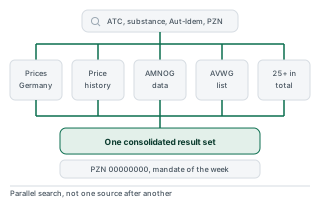
Whichever product lands on your desk, it starts in the same place. Search by ATC code, active ingredient, Aut-Idem or generic products and reach 25+ databases in one click, instead of one login per source.

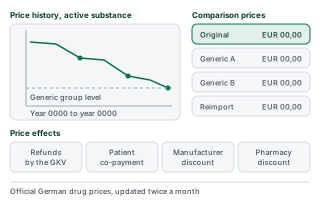
A pricing recommendation is only as defensible as the price levels behind it. Original, generics and reimports sit side by side, with the history and the effects that decide what actually gets paid.
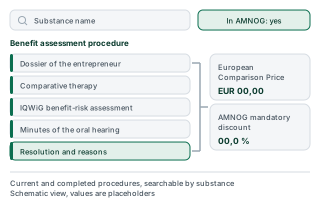
For HTA and value dossier work, search a substance name and see whether it is in AMNOG. The procedure file and the European Comparison Price are in the same view, so you do not rebuild a dossier from scattered documents.
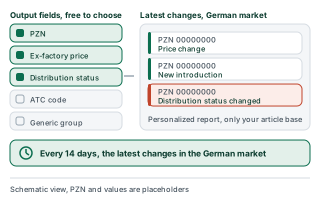
Mandates end, retainers do not. PharMonitor reports what moved in the German market on a fixed cycle, with the output fields you pick, so the update to your client is a review and not a re-run.
pharmazie.com gives market access, pricing and HTA consultancies one place to start every mandate. Whichever product lands on your desk, you search by ATC code, active ingredient or generic and reach German prices, price history, AMNOG status and the European comparison price in a single query, rather than opening a separate source for each client and each country.
A pricing recommendation is only as defensible as the price levels behind it. Original, generics and reimports sit side by side, each with its history, so a number in your deck traces back to a source rather than to a manual note. Official German drug prices are updated twice a month and drawn only from official sources, which is the standard a client will hold your report to.
For HTA and value-dossier work a substance raises two questions at once: where it stands in the German benefit assessment, and how its price compares across Germany and some further EU countries (not EU-wide, with more countries added in the coming months). Search the substance name and see whether it is in AMNOG, with the procedure file, next to the European comparison price. One view answers what usually takes two systems.
Mandates end, retainers do not. The Pharmonitor reports what moved in the German market on a fixed cycle, with the output fields you choose, so a standing client stays current without a fresh manual sweep each period. The recurring monitoring becomes a deliverable rather than an overhead.
Two things a consultancy should know before relying on us. The platform reaches 50+ countries, but coverage depth is not uniform, and for consultancy work depth is often the whole question: the German data is the deepest and international coverage varies by market. And agreed rebate contract prices between sick funds and manufacturers are confidential and not public, from any provider. We would rather say that plainly than have it surface mid-mandate.
Bring a product or a market you are working on now and we will run it in a 30-minute demo on your data, not ours.
More clarity, faster research, and faster decision-making.




.png)