





Rebate information is confidential. Nobody has it.
Consultant, pharmaceutical industry
Agreed rebate and contract prices between sick funds and manufacturers are not public, so no data provider can hand you the net price of a competitor. What you can work with is the published price layer and the statutory discount layer around it. Teams that mistake one for the other end up modelling a market that does not exist.
What you do not have is probably the manufacturer rebate, right? You probably cannot see it in the history.
Chief of Staff, pharmaceutical company
Market prices are visible, the discount behind them usually is not. Without a clean view of the ex-factory price and how it moved, every rebate calculation starts with a guess. The gap is rarely one missing number, it is knowing which of several price levels a given figure actually refers to.
[We are looking for] the option to get data on how a medicine has developed over the past 25 years.
Analyst, pharmaceutical company
Long price series are not a nice to have for market access. Inflation adjustment, reference pricing and launch benchmarks all need the earlier price, not just the current one. When the series is fragmented across sources, the analysis stalls before it starts.
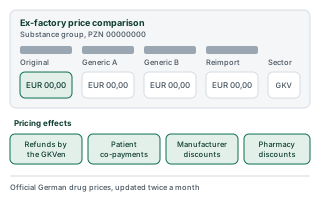
Launch Pricing Data shows what a product costs across the sectors that matter for a launch decision. Original, generics and reimports sit next to each other instead of in four separate tools.

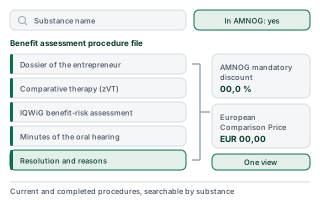
Search a substance name and see whether it is in AMNOG. The AMNOG Benefit Assessment Database puts current and completed benefit-risk procedures in one view, so you do not reassemble a procedure file from scattered documents.
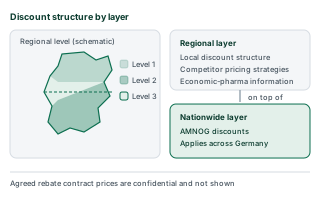
Local Pricing & Contracting Data covers the discount structure on a regional level, on top of the AMNOG discounts. It is the layer above the national picture, and it is where competitor pricing behaviour becomes visible.
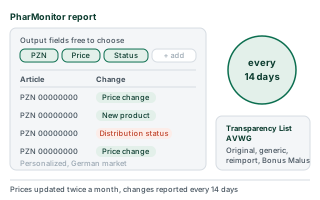
The Transparency List AVWG compares original, generics and reimports including Bonus Malus aspects. The PharMonitor then tracks what moves, so price changes across a large article base do not have to be checked by hand.
pharmazie.com brings German pricing and market access data into a single search: Rx and OTC ex-factory prices, price comparison, price history, AMNOG status and reimbursement, drawn only from official sources. Pricing and market access teams use it to see the full price picture at launch, follow a benefit assessment by substance, and track what moved in the market on a fixed cycle, instead of rebuilding each view from separate systems.
A launch price is only as defensible as the levels behind it. Original, generics and reimports sit side by side, each with its published ex-factory and pharmacy retail price, so the comparison group is visible in one view rather than assembled by hand in a spreadsheet. Price history is part of the product, which lets you follow how a price developed rather than read a single current figure.
For value and reimbursement work, you search a substance name and see whether it sits in an AMNOG procedure. The benefit assessment database puts current and completed procedures in one place, from the dossier and the IQWiG assessment through to the resolution, so you follow a substance without reassembling the file each time. The European Comparison Price appears in the same view where the procedure references it.
List price is not the price that gets paid. Above the published level sits the regional discount structure, on top of the AMNOG discounts, and that is the layer where reimbursement is really decided. The platform makes the published prices and the reference rules visible so your assumptions rest on data. One point we state plainly: agreed rebate amounts between manufacturers and sick funds are confidential, and no provider can show them.
The pattern repeats: one product looked up across four sources, a price history too short to analyse, and rebate levels that stay invisible whatever the tool. Bringing the published data into one search removes the manual reconciliation, and the Transparency List AVWG compares original, generics and reimports including Bonus Malus aspects. The Pharmonitor then reports what moved in the German market every 14 days with the output fields you choose, so monitoring becomes a delivery rather than a sweep. One honest limit: the international reference data is less current than the twice-monthly German price update, so for non-German markets ask about the exact cycle.
The fastest way to judge fit is a 30-minute demo on your data. Bring an ATC group or a substance you are pricing, and we will run it live.
More clarity, faster research, and faster decision-making.




.png)