ChatSmPC® and ChatPIL® answer questions from the text of the official summary of product characteristics and the package leaflet, analyse the content and can point you to the source behind the answer. A reading aid for your qualified staff, not a replacement for their check. Translations, for example into English, come automatically.







Even in the business account there are strong hallucinations, really with things that are not on the source page and so on.
Manager, online pharmacy group
Once a tool has produced one confident sentence that was not in the document, every later sentence has to be treated as suspect. That is the expensive part: not the wrong answer itself, but the fact that nothing it says can be used without being read back against the original. A tool you have to double check completely has saved you nothing.
[AI-generated answers are only usable] on the condition that the source is document-proof and that the source is actually there.
Manager, pharmaceutical manufacturer
In regulated work the answer is only half the deliverable. The other half is the ability to show where it came from, to a colleague, an auditor or an authority. An answer that arrives without its origin cannot be filed, cannot be defended, and therefore cannot be used.
Where does the responsibility lie, and with whom? And how do you react if something happens?
Head, international pharmacy
Customers rarely open with the word liability. They open with this question, because somebody in their organisation has to put their name under the information that goes out. Until it is clear who carries that and what happens when something goes wrong, the safe decision is to keep the tool switched off.
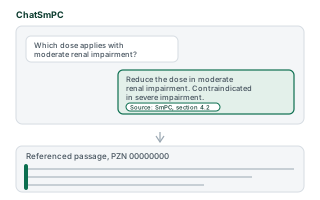
The SmPC is the document that describes the properties and the officially authorised conditions of use of a medicinal product. ChatSmPC® works on that text. You ask the specialist question and get the relevant passage back, instead of scanning the document for it.

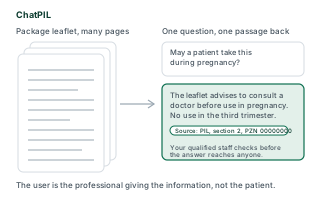
The PIL, in German the Packungsbeilage, is written by the marketing authorisation holder and is the patient-facing version of the SmPC. ChatPIL® works on that text. The user here is the professional who has to give an answer to a patient, not the patient.
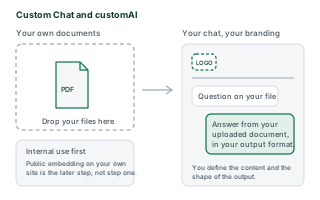
Custom Chat and customAI let you train ChatSmPC® and ChatPIL® on your own data and documents and turn your knowledge base into a chatbot with your own branding. Most customers start internally, where their own staff is the only audience, and treat public embedding as a later step.
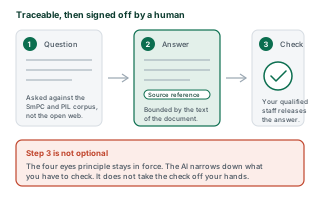
This is the part that decides whether the rest is worth anything. We mitigate hallucination risk by limiting the answer to the content of the underlying documents, and the chat can name the source behind it. The four eyes principle stays in force on top of that.
ChatSmPC® and ChatPIL® let professionals ask a question and get an answer drawn from the official summary of product characteristics or the package leaflet, together with the passage it came from. They are a reading aid for qualified staff, not a general chatbot: the answer is limited to the content of the underlying documents, and every answer is meant to be checked by a person before it is used.
The summary of product characteristics describes the properties and the officially authorised conditions of use of a medicine, and finding the one relevant line on dosing, a contraindication or an interaction can mean paging through a long document. ChatSmPC® lets you put the question directly and returns the specific passage, so you get to the sentence that matters and can read it in its original context.
In this industry the fear is not a slow answer, it is an invented one, and an answer with no source is unusable. The design limits that risk by narrowing what the model may draw on to the SmPC and the PIL, and by naming the source behind an answer so you can open the passage yourself. We do not claim guaranteed accuracy: what we claim is that the answer is traceable to a document you can verify.
Custom Chat and customAI let you train ChatSmPC® and ChatPIL® on your own data and documents, add your own branding and place the result in your own environment. A medical information team, for example, can turn its knowledge base into a chat that answers from approved internal sources rather than from the open web.
The honest answer to whether you still have to check the result yourself is yes. The AI improves the workflow, it does not replace the manual check by qualified staff, and it is not built for patients. DACON has worked with drug information since 1989, so the data behind the chats is long standing even where the chat layer on top is newer.
The fastest way to judge fit is a 30-minute demo. Bring a question your team asks often and a document set you work with, and we will show what the answer and its source look like.
More clarity, faster research, and faster decision-making.




.png)