





My problem is: I always have to look something up in the warehouse management system and enter it here. [...] The two systems do not work with each other.
Staff member, pharmaceutical manufacturer
Every lookup becomes a second job: find the value in one system, retype it into the other. The two systems never learn from each other, so the same manual bridge has to be rebuilt every single day, by every single person who needs the data.
This is a manual process for us that costs a lot of time. I do not like manual processes, because they are inherently error prone.
Head of Business Intelligence, online pharmacy
Article master data arrives from several sources, maintained to different standards, and someone has to reconcile it. The cost is not only the hours spent, it is the quiet risk that a stale price or an outdated status reaches a decision nobody double checks.
We do not want to hold large volumes of data in our own portal, we would rather call a service again and again through an API.
Managing Director, software vendor for pharmacies
Holding a copy of a drug database means owning its upkeep forever, and clicking through a front end is not an option when a machine needs the answer. Without a direct data connection, teams either build a mirror they did not want or fall back on manual exports.
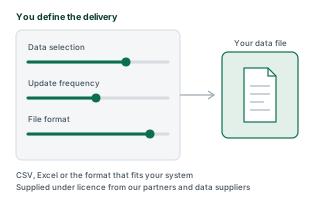
In our service download you decide which data you want and how often you want it updated. You also define the file format that best suits your system, so the file lands ready to import instead of ready to rework.

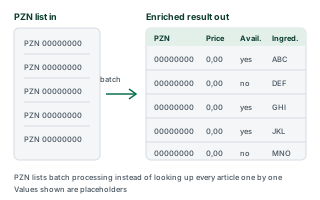
PZN lists batch processing lets you hand over a list of articles instead of looking each one up by hand. The PZN stays your primary key, so the result maps back onto the master data you already keep.
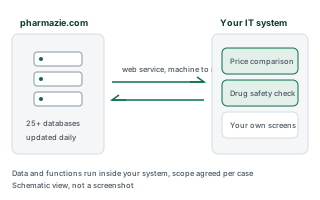
Our web service enables machine-to-machine communication via the Internet. You use our data and our functions on your IT systems, for example calling up our price comparison or drug safety check directly on your machine, in your system.
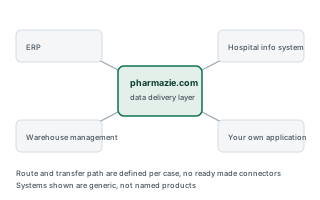
The point of a data service is that the data ends up where the work happens. Whether that is an ERP, a warehouse management system, a hospital information system or a product you build yourself, we define the delivery together rather than handing you a generic connector.
pharmazie.com delivers German and international drug data into the systems your team already works in, either as a file export built to your specification or through a machine-to-machine web service. The platform is updated daily from 25+ databases and only from official sources, so the data you receive reflects the current market rather than a snapshot you have to reconcile by hand.
Two routes, and which one fits depends on how you work. The web service enables machine-to-machine communication over the internet, so you call our data and our functions, for example a price comparison or a product lookup, from inside your own IT systems. The alternative is a file export: a recurring data download that lands where your ERP, warehouse management system or own application picks it up. Neither asks your team to hold large data volumes in a separate portal, which is the setup most customers are trying to leave behind.
In the data download service you decide which data you take and how often you refresh it, and you define the file format that best suits your target system. The PZN stays your primary key, so a delivery slots into the records you already keep rather than forcing a new identifier on them. Where your system needs a specific field order or layout, that shaping can be prepared as a service instead of leaving you to reformat every file.
PZN list batch processing lets you hand over the list of articles you carry instead of looking each one up. You get back what changed against the current data set: prices, status and the fields that moved, in the shape you asked for.
The underlying platform is refreshed daily, and price data is visible three to five days before its effective date, which is the window that lets you recalculate before a change takes effect. The honest limit is on the delivery side: for a file based export the currency is set by the frequency you choose, so a weekly file is a week old on day six. A more frequent pull, or the web service, closes that gap. One recurring request we hear is delivery by FTP, and it is worth raising early, because we prefer to scope it per case rather than publish it as a blanket option.
The clearest way to judge fit is a 30-minute demo on your data. Bring the format your system needs and the PZNs you work with, and we will walk through how the delivery would look.
More clarity, faster research, and faster decision-making.




.png)