





Right now we have four separate information systems running in parallel for prescription processing.
Head of hospital pharmacy, university hospital
Every system holds its own version of the article master, and none of them agrees with the others. Somebody has to decide by hand which record is right, on a Tuesday afternoon, under time pressure. The fragmentation stays because no single system owns the data, so no team owns the fix.
We have an Excel spreadsheet with drug data that has grown over decades.
Staff member, hospital pharmacy
The spreadsheet started as a workaround and turned into the system of record. It has no owner, no validation and no update path, but the operation depends on it. Replacing it means admitting how much of the process actually lives there, which is exactly why it survives another year.
The mapping of PZN to EU numbers is unreliable; manufacturers change them without communicating it.
Staff member, pharmaceutical wholesaler
A product number that no longer exists does not announce itself. It sits in the master data until an order fails, a report is wrong or a check runs against a package that was changed months ago. Because the change happened outside your organisation, no internal process catches it.
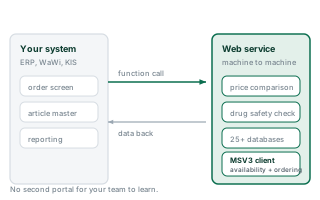
Our web service enables machine-to-machine communication over the internet, so you can use our data and functions on your IT systems. Your team keeps working in the ERP, warehouse management or clinical system they already use.

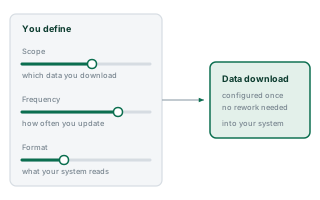
In our service download you decide what you take and how current you keep it. The point is that the file lands in a shape your system reads without a cleanup step in between.
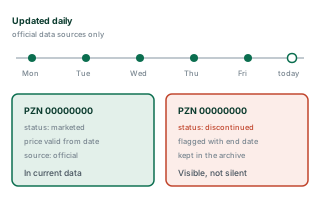
The platform is updated daily from 25+ databases and we only use official data sources. Discontinued products are not quietly dropped: the ABDA-Database Archive keeps them, so a record that ended still has a place to be looked up.
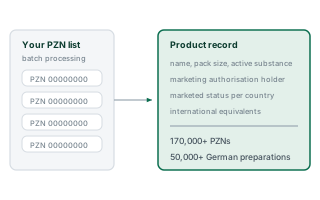
Product identification is where most master data work starts and stalls. You can process PZN lists as a batch rather than one number at a time, and the record behind each number carries what your systems usually lack.
pharmazie.com gives IT teams a way to bring German and international drug data into the systems they already run, either by calling our functions over a web service or by receiving a data delivery shaped to their target system. The platform is updated daily from 25+ databases and only from official sources, so what reaches your landscape is current data rather than a static file someone has to keep patching by hand.
The web service enables machine-to-machine communication over the internet, so functions such as a price comparison or a product lookup run inside your own applications rather than beside them. The alternative is a data download in your scope, frequency and format: you decide what you take and how current you keep it, and the file arrives in a shape your target system reads instead of one you have to convert. Which route fits depends on whether you want live queries or scheduled deliveries, and many teams use both.
The platform itself is refreshed daily, and current price data is visible three to five days before the effective date, which gives your downstream processes room to react. For a file based delivery the currency follows the frequency you set, so the update cadence is a design decision rather than a fixed rule. Discontinued products are not quietly dropped: they stay findable in the archive database, so a record does not vanish out from under a mapping that still references it.
Here we would rather be straight now than in week six of a project. There is no ready-made connector for SAP, Sage 100, Navision, ADG, Prokas, Pharmatechnik or the other pharmacy warehouse systems. What the web service gives you is a defined way for our data and functions to be used on your IT systems, and the download gives you a file built to your specification. Integration into a specific target system is work your side or a partner does, on a documented foundation.
Mostly breadth and the international layer: 25+ databases, 50,000+ German and 120,000+ international preparations and 170,000+ PZNs in one place, kept current from official sources. The limit is the one above: this is a data and interface layer, not a turnkey connector, so plan for the last mile into your system. PZN lists and international equivalents process as a batch, usually where master data work starts and stalls.
The clearest way to judge feasibility is a 30-minute technical demo on your case. Bring the systems you need to feed and the format they expect, and we will walk through what integration takes.
More clarity, faster research, and faster decision-making.




.png)