





We see goods as available, we order them, and then the answer is that they are not available at the manufacturer.
Buyer, pharmaceutical company
The catalogue says one thing, the supplier says another, and the gap only shows up once the order is already out. Every one of those orders turns into a phone call, a re-plan and a delay that lands on a patient's therapy or a customer's delivery date. Nothing in the process is wrong, the information simply arrives too late to act on.
The cumbersome manual work we do every week just to see [...] which alternatives even exist.
Head of Supply Chain, generics manufacturer
Finding a replacement means jumping between systems: one to establish the product is out, another to look for what else carries the same active substance, a third if the answer might sit abroad. The work repeats every week and produces nothing that can be reused. It is the same research, done again, because none of it was ever written down in one place.
Every Friday it is torture to go through this list.
Purchasing team member, import pharmacy
The shortage list lives in a spreadsheet that someone has to walk through line by line, checking each product against the sources by hand. It is stale the moment it is finished, and it silently accumulates product numbers that no longer exist. The cost is not only the hours, it is that decisions get made on a list nobody fully trusts.
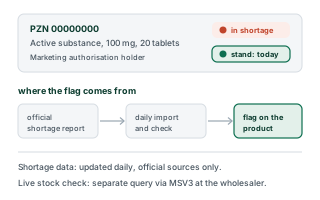
Shortage data is updated daily and comes from official sources only, so the flag sits on the product record rather than in a PDF you have to go and find. Where you need the physical stock position rather than the regulatory status, the MSV3 interface queries your wholesaler live. Those are two different questions and the platform keeps them apart.

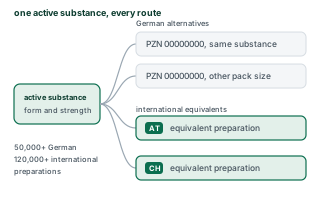
A shortage is only a problem until you know what replaces it. The route runs through the active substance, the dosage form and the strength, and it does not stop at the German border: 50,000+ German and 120,000+ international preparations are in the same search space. You can also filter for the products where no alternative exists at all.
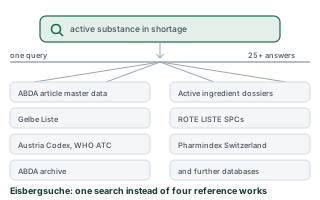
The Eisbergsuche queries 25+ databases at once instead of making you work through them one by one. For a shortage that means the German master data, the active ingredient dossiers, the Austrian and Swiss dictionaries and the archive all answer the same question in one pass.
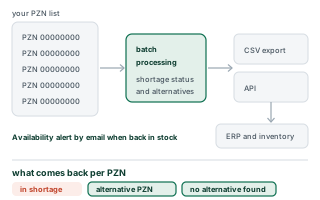
You should not have to copy and paste product numbers out of a browser to keep your own list current. Upload a PZN list and get the batch back with shortage status and alternatives attached, as an export or through the API into your ERP or inventory system.
pharmazie.com gives industry professionals the German shortage reports refreshed every day from official sources, and pairs each one with the alternatives that answer it. A shortage on its own only tells you what you cannot buy. The value is the next step: which equivalent exists, in which market, and whether it can actually be sourced. That step sits in the same search, so the flag on a product record leads directly to what replaces it.
Daily. The shortage data in the platform is refreshed every day and drawn from the official regulatory reports, in Germany from the BfArM, which are themselves based on notifications from marketing authorisation holders. Being precise here matters, because a daily update is not the same as a real time feed: the record reflects what has been officially reported, kept current, rather than a supplier's live stock position.
Yes, and for many customers this is the reason they use the platform at all. The route to the alternative runs through the active substance, the dosage form and the strength, so a candidate is a genuine equivalent rather than a name that looks similar. The search space covers 50,000+ German and 120,000+ international preparations, so when nothing suitable is available domestically the same query reaches equivalents and imports in other markets. The parallel search, our Eisbergsuche, queries 25+ databases at once instead of making you work through them one by one.
Yes. You should not have to copy product numbers out of a browser to keep your own list current. PZN list batch processing takes the list you already keep and returns the shortage status for every article in one pass, and the result comes back as an export or through the API, so the recurring spreadsheet check stops being a manual ritual.
The pull is that shortage research and substitution become one job instead of a tour of supplier portals. And what makes it stand out: there is proactive alerting. The platform pushes a message when a product becomes available again. It is a capability many of you asked us for, and we built it in response.
The quickest way to judge fit is a 30-minute demo on your data. Bring the products you are chasing alternatives for, and we will search them together.
More clarity, faster research, and faster decision-making.




.png)