





Since the house list is exported and taken over automatically in SAP, nobody wants to do that by hand.
Head pharmacist, university hospital
Everything around the pharmacy is automated, and then the drug data arrives as a task for a person. The manual step is not a habit, it is what is left when the reference data and the system that consumes it were never designed to meet. It survives because it always works well enough to postpone the real fix by another quarter.
It is a drama every time. If the data update does not finish at the weekend, on Monday we have the wrong data in the system.
Managing director, supplying pharmacy
Nobody notices a stale record until an order fails, a report is wrong or a package that changed months ago is dispensed against an old entry. The change happened outside the house, so no internal process catches it, and the correction lands on whoever is on shift. That is why the cleanup is always someone doing it again by hand.
We look into every wholesaler separately, enter the PZN and see whether it is available. [A central search] would be a big time saving.
Pharmacist, military hospital
The information exists, it is just scattered across as many logins as you have suppliers. The cost is not the missing answer, it is the walk to get it, repeated for every product on a day when shortages are the normal state. And because each system is fine on its own, no single vendor ever owns the fragmentation.
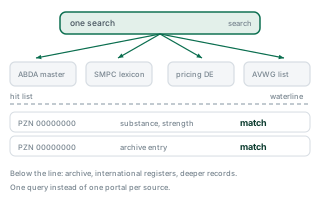
Icebergsearch queries the databases you would otherwise open one after another and brings the results back together. Hospital pharmacies tell us the inefficiency is not any single lookup, it is the number of places a lookup has to happen.

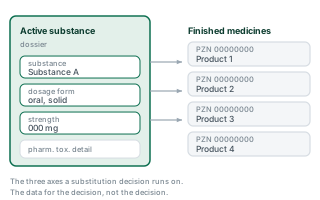
A substitution decision runs along three axes, and those are exactly the axes your ERP usually does not carry. The active substance dossiers hold the pharmacological and toxicological detail behind the product, so the comparison happens on the substance and not on a product name.
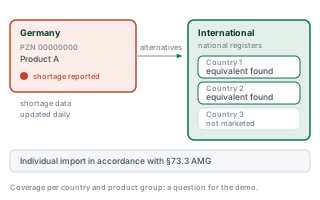
When a product is not available locally, the answer is usually already on the market somewhere else. Our customers use the ABDA database German Finished Medicines together with International Medicines to open international procurement routes for medicines that are unavailable in Germany, for example individual imports in accordance with §73.3 AMG.
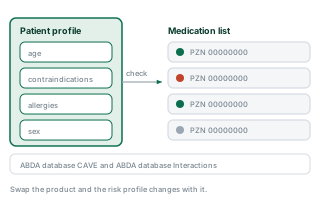
Once you have swapped a product, the risk profile has changed with it. The CAVE and interaction modules run the check against the ABDA databases rather than against a house list somebody maintains on the side.
pharmazie.com brings the databases a hospital pharmacy would otherwise open one after another into a single search. You look up a substance, check a substitution across substance, dosage form and strength, run a CAVE and interaction check, and reach international sources when a product is not available in Germany, all from one query over 25+ databases drawn only from official sources.
A substitution decision runs along three axes, and those are exactly the axes a hospital ERP usually does not carry. The Icebergsearch queries the connected databases together and returns the active substance, dosage form and strength on one card, so you judge whether a candidate genuinely matches instead of reading three systems side by side. That is the daily work of a hospital pharmacy, compressed into one lookup.
When a product is not available locally, the answer is often already on the market somewhere else, and a documented shortage is what legitimises an individual import under §73(3) AMG. Through the ABDA database German Finished Medicines together with the international medicines data, you find the PZN and the foreign equivalent in the same view, which is what customers in international procurement use us for.
Once you swap a product, the risk profile changes with it. The CAVE and interaction modules run the check against the ABDA database, so a substitution and its safety review sit in the same place rather than in a second tool opened after the fact. Shortage data for Germany is updated daily and carries EU and international alternatives, so the lookup stops being a tour of supplier portals.
One expectation we correct up front rather than let you discover later. Master-data delivery and ERP synchronisation are not part of what this page covers, so if automated export into SAP is the requirement, that is a different conversation.
The fastest way to judge fit is a 30-minute demo on your own products. Bring a section of your house list or a shortage you are working now, and we will run it live.
More clarity, faster research, and faster decision-making.




.png)