







Key BenefitsThe German ABDA Drug Interactions Database documents interactions between medicines approved in Germany, their active substances, herbal preparations, nutritional supplements and foods. Every entry describes the effect on the patient, the underlying mechanism, the action required and the special characteristics of the interaction.
An interaction is included when it carries an expected risk to the patient. Purely in vitro incompatibilities, general effects of macronutrients and contraindications without an interaction mechanism are deliberately excluded.
Every interaction is described in a structured monograph so that the clinically relevant information can be read at a glance and traced back to its evidence.
Each interaction carries a graded assessment of its clinical significance, ranging from contraindicated combinations with likely serious consequences through to combinations that generally require no action. The classification lets you triage a medication list quickly and focus attention on the entries that matter.
Any number of medicines can be checked against one another in a single query. You can search by active substance, for example acetylsalicylic acid, or by finished branded product, for example Aspirin, and combine both in the same review.
The interaction check is also available as a web service that integrates directly into your own system through an XML or deeplink interface. Medication and patient data can be passed in automatically, which supports medication review inside hospital and clinical information systems.
The data is compiled and evaluated by the specialist editorial team at ABDATA Pharma-Daten-Service in Eschborn, Germany, with references drawn from primary literature and online databases. Content is updated every two weeks.
Each interaction is documented consistently, so the effect, mechanism and required action can be read and cited without ambiguity.
A graded classification ranks every interaction from contraindicated to no action required, so critical combinations stand out immediately.
Cross-check an unlimited number of medicines in a single review, searching by active substance or finished product.
Embed the interaction check into your own environment through an XML or deeplink interface, with medication and patient data passed in automatically.
Identifying drug-drug interactions is one of the most demanding parts of a medication review. With the number of medicines approved in Germany, and with patients frequently taking several products at once, manual checking against the primary literature is neither fast nor reliable. A database that has already evaluated the evidence and graded each interaction by severity turns that task into a structured, repeatable check.
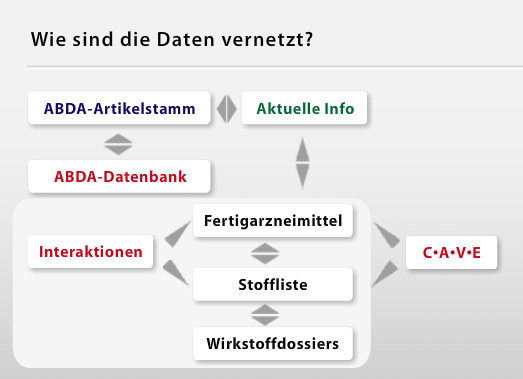
The database does not simply flag that two substances interact. It records what the interaction does to the patient, why it happens, and what to do about it, together with the evidence behind the assessment. Because entries are graded by clinical significance, the combinations that require a contraindication or close monitoring are separated from those that generally need no action, which keeps professional attention on the genuinely relevant risks.
Interactions are not limited to prescription drugs. Over-the-counter products, herbal medicines and nutritional supplements can all change how a medicine behaves, and the database includes them where their ingredients can cause a clinically relevant interaction. Foods and substances such as ethanol are covered as well: around thirty monographs describe clinically relevant interactions between ethanol and active substances, which helps put common assumptions, for example about antibiotics and alcohol, on an evidence base rather than on rules of thumb.
Every monograph is evaluated by the ABDATA editorial team against primary literature and online sources, and the content is refreshed every two weeks. That combination of curation and a fixed update cycle is what makes the data dependable enough to build medication-review workflows on.

.png)