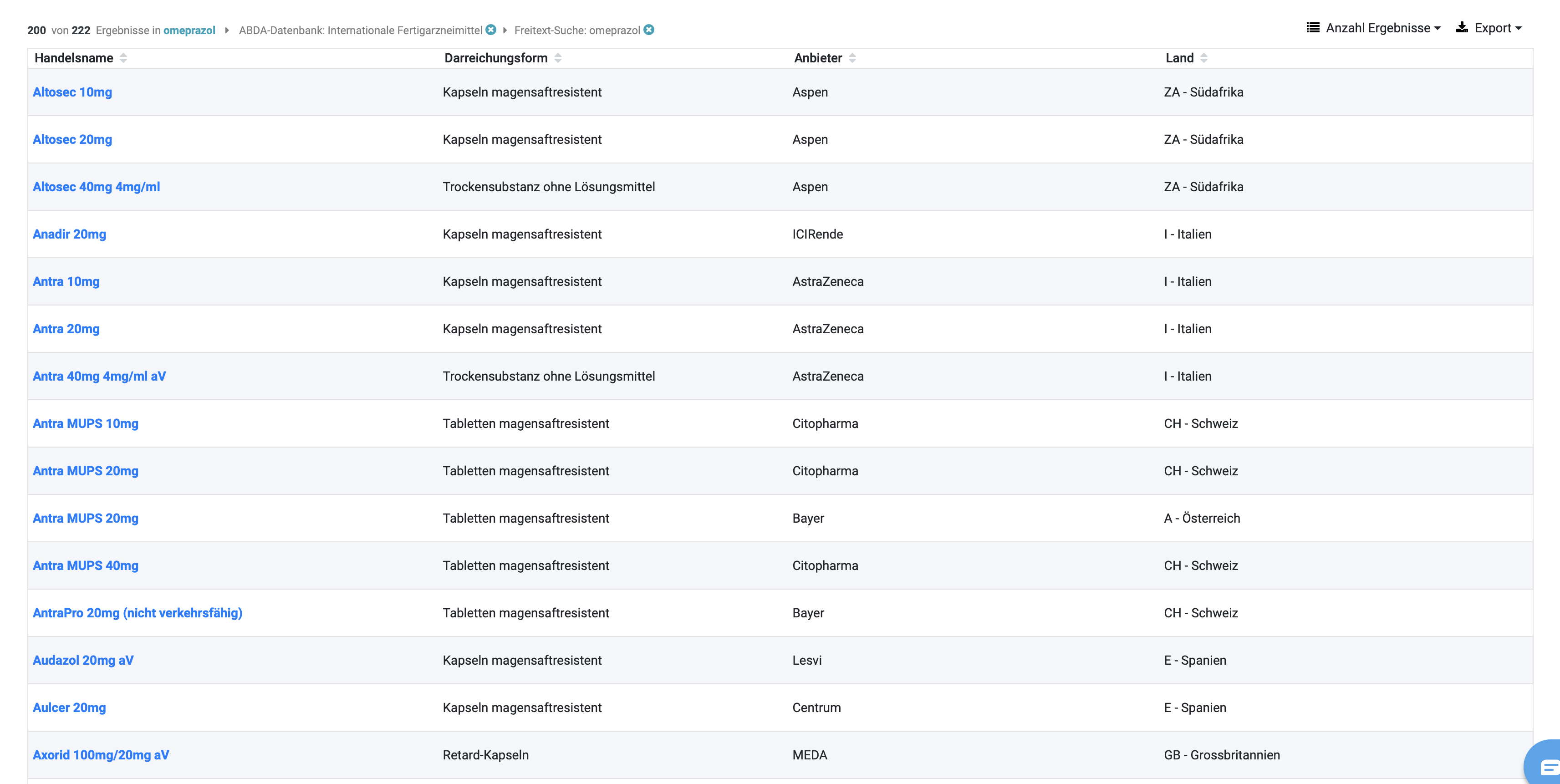







Key BenefitsThe ABDA Database International Finished Medicines brings together comprehensive information on originator products and generics from Germany, Switzerland, Austria and more than 50 countries. Instead of researching national registers one by one, professionals query a single, structured source that spans over 120,000 internationally registered medicines.
Each entry combines regulatory and pharmacological detail: marketing authorization holder, trade name, ATC code (WHO), dosage form and structure, provider and co-distributor, country of registration, and full composition down to each active ingredient and its quantity.
The database supports teams that need a cross-border view of the finished-medicines market: pharmaceutical manufacturers benchmarking products and holders, pharmaceutical trade sourcing internationally available alternatives for locally unavailable medicines, market access and pricing teams, and hospital pharmacies evaluating procurement options. Because every result links back to the wider pharmazie.com database landscape, a single active ingredient or authorization holder can be traced across markets in one click.
The data is sourced from ABDATA Pharma-Daten-Service, Eschborn, Germany, and updated every two weeks.
Every record carries the complete, structured contact and identity data of the marketing authorization holder behind a product.
See all search results for a specific authorization holder across every pharmazie.com database, so a single query spans the full data landscape.
Identify the authorization holder for more than 120,000 internationally registered medicines across over 50 countries, covering originator products and generics alike.
View active ingredients with their pharmacological and toxicological profile, alongside clinical data for each product.
Finished-medicines data rarely lives in one place. Every country maintains its own register, with its own trade names, dosage conventions and authorization holders, which makes a cross-border question, such as which products contain a given active ingredient at a given strength, surprisingly hard to answer. The ABDA Database International Finished Medicines was built to close that gap by consolidating originator and generic products from more than 50 countries into a single, structured search.
When a medicine is not available locally, procurement teams need a fast way to find equivalent products in other markets. A structured, cross-country view of trade names, compositions and authorization holders supports sourcing decisions, for example single imports into Germany under Section 73(3) AMG, without manual research across national registers.
Teams working on clinical studies use composition data to compare products across approved markets and to list every product that carries a specific active ingredient at a specific concentration. Having that list on a single click shortens the work of identifying suitable comparators and candidates.
Because each entry connects to the wider pharmazie.com landscape of 25+ databases, an authorization holder or active ingredient can be followed from the international finished-medicines view into related regulatory, pricing and substance data. The result is a consistent picture of a product across markets rather than a set of disconnected national snapshots.

.png)