MSV3: How Germany Orders Medicines

The 35-page guide to the German ordering standard that everyone uses and few can explain. Technology, history, market map, and the five limits worth knowing before you plan a project. Written in German.
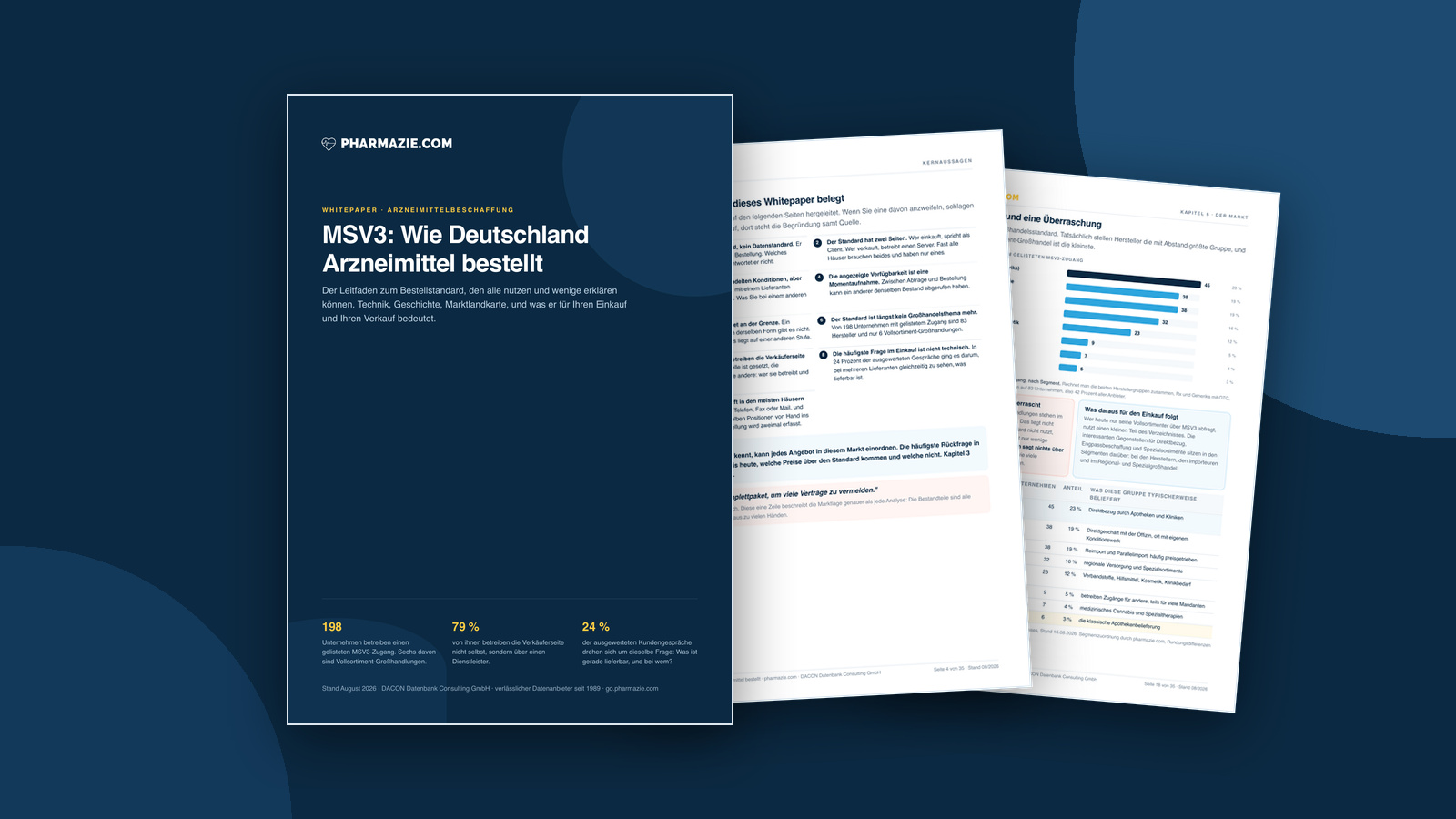

Cover and inside pages of the pharmazie.com whitepaper on the MSV3 ordering standard
Trusted by over 1000 pharma professionals from
Download this if ...
No items found.
Key Benefits

The short version

  • MSV3 is an ordering standard, not a data standard. It carries availability and orders. Which product is the right one is a question it does not answer.
  • The standard has two sides. Whoever buys speaks as a client. Whoever sells operates a server. Almost every trading company needs both and has one.
  • It carries your negotiated terms, but no market price. What you agreed with a supplier comes through. What you would pay at a supplier you have no account with does not.
  • Four out of five do not operate the selling side themselves. Of 198 companies with a listed access point, only a minority run it in house.
  • The most frequent question in purchasing is not technical. In 24 percent of the sales conversations we analysed it was the same one: what is available right now, and from whom?

Chapters 1 to 9 describe the standard independently of any vendor. Chapter 10 onwards is our own answer, and it is marked as such.

Why we wrote this

MSV3 is one of those standards that everyone uses and few can explain. There is a specification for developers and there are vendor product pages. Between the two sits a gap, and in that gap work the people who have to order every day. This whitepaper fills it.

The first nine chapters sell nothing. They explain the standard, its history, its limits and the market around it, including where that does not speak in our favour. A whitepaper that advertises from page three is not passed on, and being passed on is the whole point.

What is inside

  • Chapter 1 to 2: the procurement task the standard only partly solves, then MSV3 itself. Client and server, the seven services by name, the anatomy of a query with all ten response codes, and the ordering path.
  • Chapter 3 to 4: the history from the serial ISDN line of 1985 to the web service, which prices come along and which do not, and how MSV3 sits next to EDI with EANCOM.
  • Chapter 5: five limits of the standard, plus three misconceptions we clear up regularly.
  • Chapter 6 to 7: our own analysis of the public provider directory. 198 companies after clean-up, eight segments, and who operates the selling side in house, segment by segment.
  • Chapter 8 to 9: four everyday situations, and the process before and after, step by step.
  • Chapter 10 to 11: our own answer, four entry levels, prices in figures, and a seven-question checklist you can use on any vendor, including us.

Who it is written for

Purchasing, sales, IT and management in pharmaceutical trade, industry, hospital supply and at the vendors of warehouse management systems. In short, everyone who orders, wants to be ordered from, or both.

Where the figures come from

Three sources, kept apart. The public documents of the standard bodies and our own technical article on services and response codes. Our own analysis of the public MSV3 provider directory as of 16 August 2026: 212 listed access points, 198 companies after clean-up. And sales conversations from our own team between May 2025 and August 2026, quoted only as a share, never as an absolute number.

Highlights of this free download

The nine key statements on one page

If you read only one page, read that one. It is written so that you can join the conversation afterwards, and every statement is derived in the chapter behind it.

The market map: 198 companies, eight segments

Our own analysis of the public provider directory. Who actually operates an access point, in which segment they sit, and where the selling side is run in house rather than bought in.

Five limits no vendor can lift

No market price, no guaranteed availability, no suppliers outside Germany, no security answer inside the standard, and no multi-tenancy as a given. Four of the five apply to every vendor equally.

The seven questions to ask any vendor

A checklist for your selection process, deliberately written so that you can apply it to us as well. Question four and question seven are the ones with the highest yield.

More background information

  • 35 pages, in German, free of charge
  • The nine key statements on a single page
  • A market map nobody else has published
  • A vendor checklist you can use on us too

Questions about this free ressource

What exactly do I get?
Am I going to be called now?
Is the whitepaper an advertisement for pharmazie.com?
Is it relevant if I do not work in Germany?
Why do I have to leave my contact details?
May I pass the whitepaper on?
Since 1989, over 1,000 customers have placed their trust in our data.

The most comprehensive drug database for pharma professionals.