Market Access, Pricing and Regulatory teams use pharmazie.com to see competitor prices and price history, check which discount contracts cover which health insurers, and find out what experts see about their products across 25+ drug databases.






We need a market overview, including competitors' tender and price data.
Market Access lead, pharmaceutical manufacturer
Fifteen of twenty-two conversations came back to the same thing: the price gets set without a reliable view of what the rest of the market is doing. Not a modelling problem, a visibility problem.
Our existing data sources are hard to export and offer no EU product mapping.
IT lead, pharmaceutical manufacturer
The analysis never happens in the database. It happens in Excel, in the BI tool, in the ERP. When the data cannot leave cleanly it gets retyped, and the copy is out of date the moment it is made.
Can I see how often a product has already been out of stock, or only its current status?
Supply lead, pharmaceutical manufacturer
A current shortage flag answers today's question. It does not tell you whether a competitor's product fails every spring, which is the thing you would actually plan around.
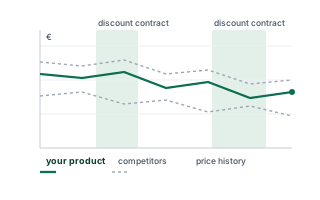
Rx and OTC ex-factory prices, price comparison and price history in one place, next to the discount contracts agreed between manufacturers and health insurance companies.

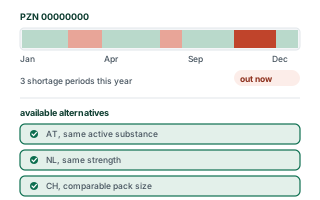
Germany's reported shortages, updated daily, sitting next to the international data that says what can be sourced instead. Useful whether the gap is yours to fill or yours to survive.
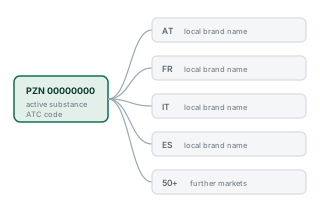
Active substance and product search abroad across 50+ countries, structured by ATC code so a German product and its foreign counterparts line up rather than having to be hunted separately.
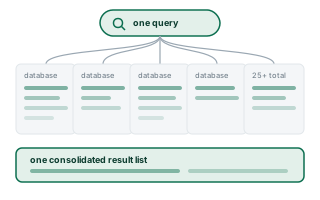
The iceberg search runs one query across 25+ international databases at once. It is also how you see what experts see about your own products, in the 20 drug databases they consult.
pharmazie.com gives manufacturers one search over 25+ databases, so a pricing decision rests on the market rather than on today's list figure alone. You see Rx and OTC ex-factory prices, price comparison and price history next to discount contract coverage, check what is short and what is available instead, and find your product across 50+ countries, without opening a separate source for each question.
Pricing into the dark is the complaint we hear most. Original, generics and reimports appear side by side with their published prices, and the discount contracts agreed between manufacturers and sick funds show where coverage already exists per product and fund. Price history is part of the product, so you follow how a level developed over time rather than reading a single current figure, which is what a defensible pricing case needs.
A German price rarely stands alone. The active substance and product search reaches across 50+ countries, structured by ATC code, so a German pack and its foreign counterparts line up in one view. The iceberg search runs a single query across 25+ international databases at once, which is also how you see what an expert would find about your own products abroad.
Reported shortages for Germany are updated daily from official sources, and the equivalents that answer them appear alongside, from Germany and from other markets. For a manufacturer that is a signal in both directions: where a competitor is short, and where your own product is the available alternative. How far the shortage history reaches back depends on the record, so treat it as a pattern rather than a guarantee.
The reasons repeat: a source that will not export cleanly, no EU product mapping, and only today's status when the question is the trend. What we will not claim is the part no legitimate provider can give you: the prices agreed inside a specific discount contract or tender are generally not public.
The fastest way to judge fit is a 30-minute demo on your data. Bring a product or an ATC group you are pricing, and we will run it live.
More clarity, faster research, and faster decision-making.




.png)