






Key BenefitsThe Drug Pricing Germany Tool is built on the ABDA Article Master from the ABDATA Pharma-Daten-Service in Eschborn. It brings together pricing, pack, legal and supplier information for the medicinal products marketed in Germany, and keeps that information current with updates every two weeks. Every article is identified by its Pharmazentralnummer (PZN), which makes matching, price calculation and reporting reliable rather than approximate.
Pricing for prescription medicines in Germany is complex and tightly regulated, and the underlying data lives across several sources. The Drug Pricing Germany Tool consolidates it into one place, so that pricing, compliance and market-access decisions rest on current, verifiable data.
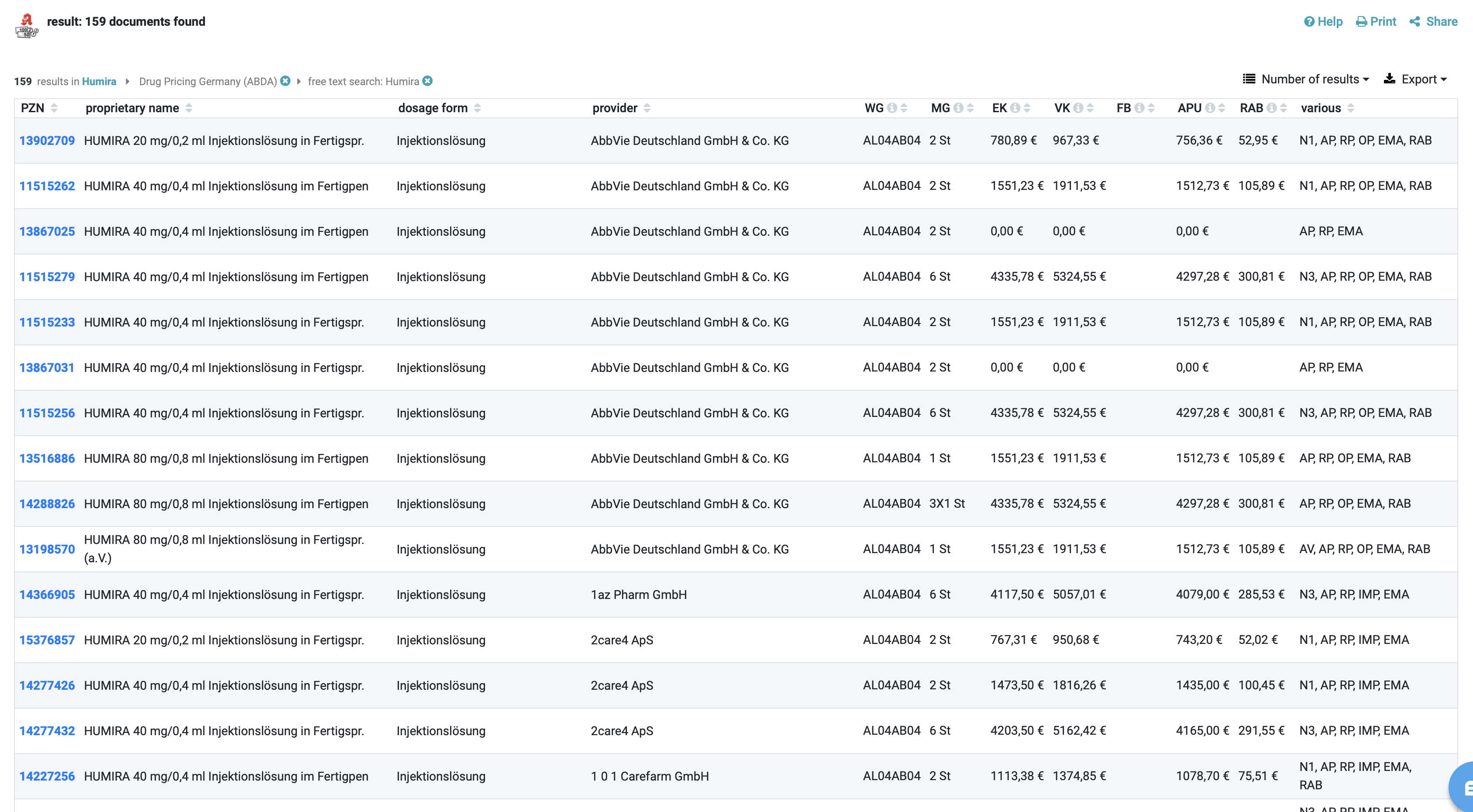
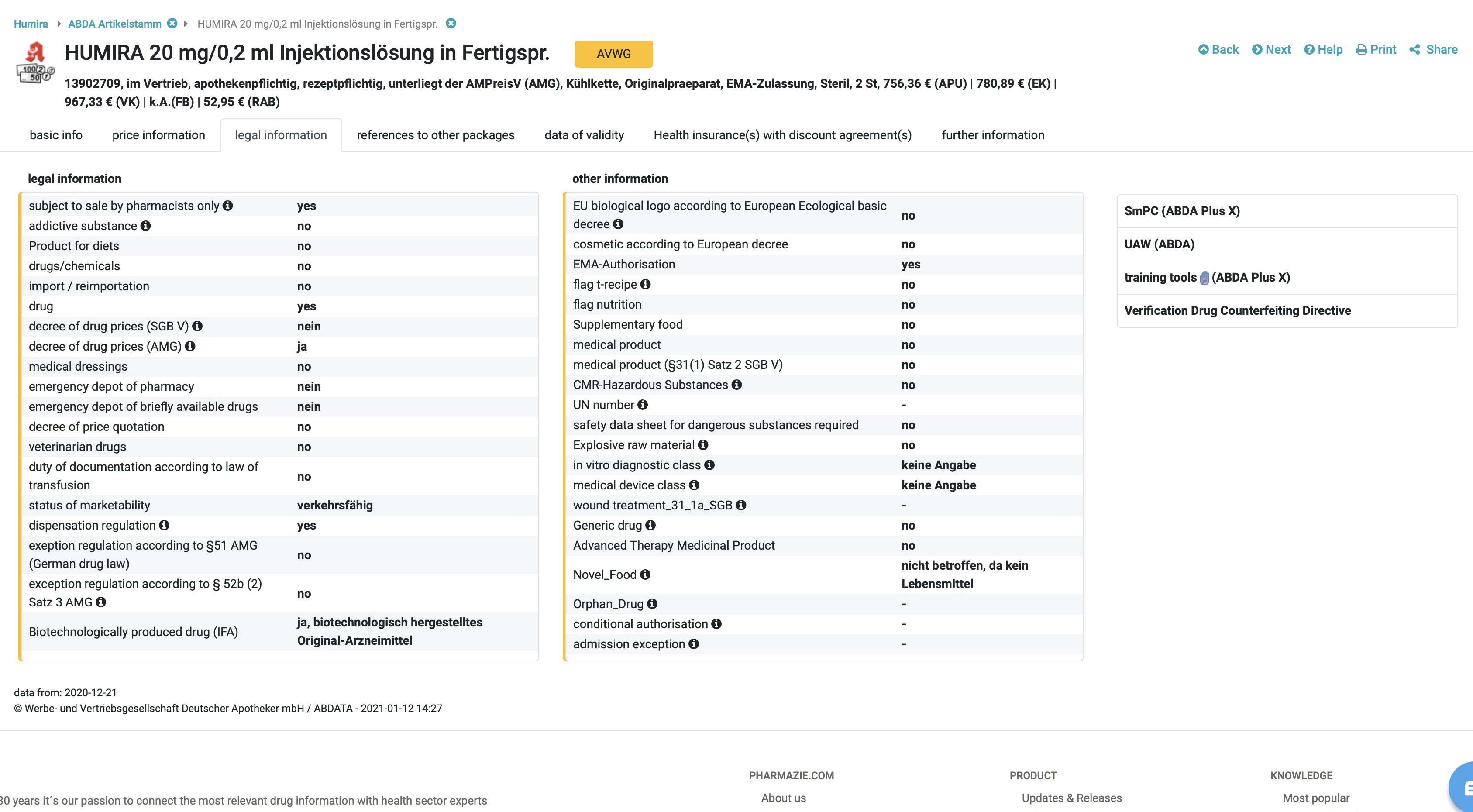
Search by free text, for example a product name or PZN, and the tool returns the matching articles. From the result list you reach the detail view for a specific product and manufacturer, its legal information, and a side-by-side price comparison across packs and equivalents. The screenshots below walk through that flow, from search to price comparison.
The data originates from the ABDATA Pharma-Daten-Service in Eschborn, Germany, and is refreshed on a two-week cycle. That cadence keeps prices, rebate contracts and legal status aligned with the current state of the market.
The ABDA Article Master covers the medicinal products marketed in Germany, each anchored to its Pharmazentralnummer. A single free-text search returns the article, its pack sizes and its dosage forms, so research and matching start from one reliable identifier.
For prescription medicines the price chain is fixed by the AMPreisV: fixed surcharges are added to the manufacturer's selling price up to a retail price that is identical in every pharmacy. The database carries that chain so you can calculate and verify prices instead of estimating them.
Each article is classified against the relevant German and EU frameworks, from the Arzneimittelgesetz to medical device, dietetic, food supplement and cosmetic regulation. Prescription status, pharmacy-only status and narcotic classification are recorded, which gives compliance and regulatory teams a defensible basis for their decisions.
The optional PZN individuell package turns the database into a working tool for your own portfolio. Upload your PZN lists, configure filters and export the results for analysis in your own systems, including a competitor price comparison and the four most cost-effective analysis.
The value of the Drug Pricing Germany Tool lies in the structure behind it. A few reference points help explain what each record contains and why it is reliable.
The PZN is the unique identifier for every article in the German market. Around it sit the article description (a short name and a long name), the dosage form, the package size and unit of measurement, the article type and the ABDATA product group code. That product group code is itself hierarchical: the code AN02BA01 for acetylsalicylic acid resolves from A (ATC assortment) through AN (nervous system), AN02 (analgesics), AN02B (other analgesics and antipyretics) and AN02BA (salicylic acid and derivatives) down to the specific substance.
Articles are classified according to the framework that governs them: medicinal products under the AMG, veterinary medicines, medical devices under current medical device law, drug and chemical starting materials, dietetic products, food supplements under the NemV, food under the LFGB, cosmetics under Regulation (EC) No. 1223/2009, and authorised biocides or plant protection products.
For prescription medicines, the AMPreisV under the AMG governs the calculation from the manufacturer's selling price through fixed surcharges to the final price, which is identical in every pharmacy. That is why the retail price of a prescription product does not vary between pharmacies.
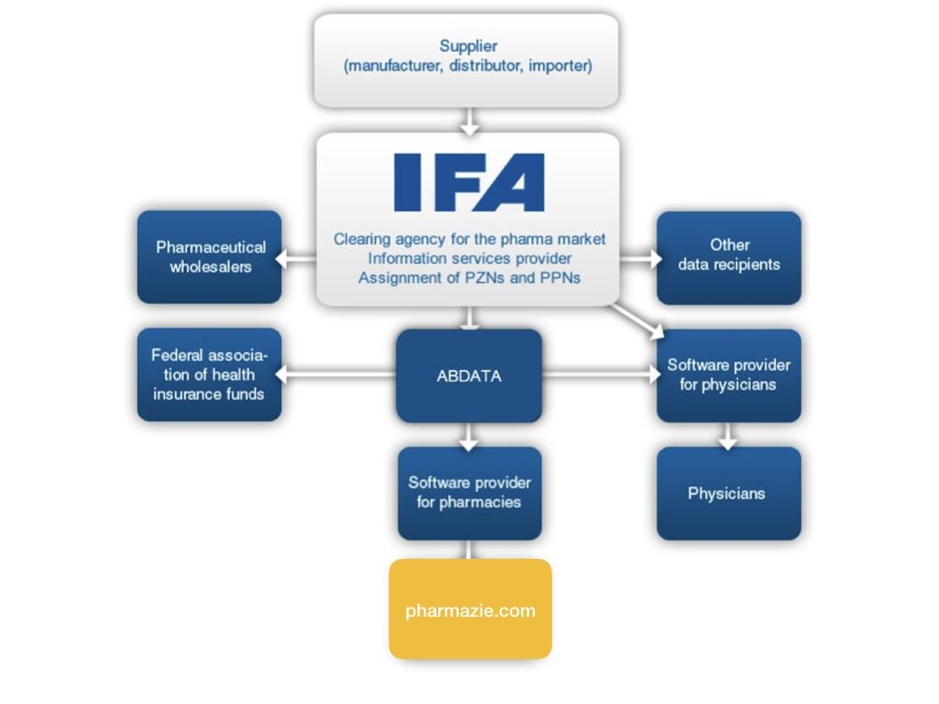
Records carry distribution channels (public pharmacies, wholesalers, hospital pharmacies and retail outlets), sales status (in sales, out of sales or withdrawn) and successor references, backed by an integrated supplier address database based on IFA data. Packing and storage attributes are included too: required storage temperatures, cold-chain and dry-storage needs, breakage risk, positioning and light protection.
Frequently used markers include AP (pharmacy required), BTM (narcotic), EK (pharmacy purchase price), VK (pharmacy sales price), IMP (reimport), KP (clinic pack), N1, N2 and N3 (therapy-appropriate pack sizes), NL (negative list), OR (original preparation) and RP (prescription).

.png)